Tuesday, June 30, 2015

The Dragonflies of Somme

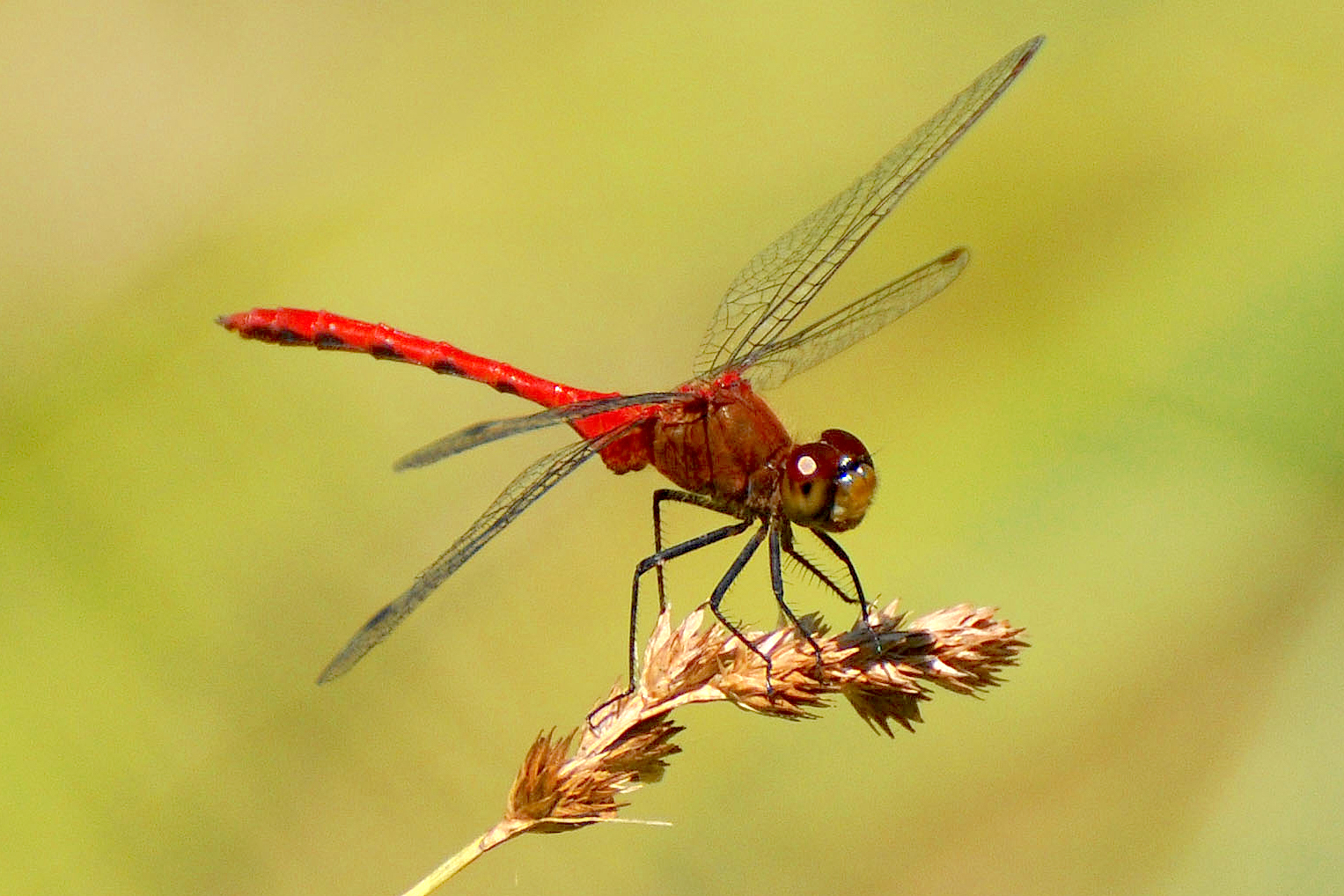
Photos by Lisa Musgrave - professionally a tennis coach, not a dragonfly expert. As she found and identified these treasures over the years, she was also photographing birds, flowers, coyotes, and more - also contributing expertise and physical work to the restoration of all three Somme preserves and functioning as co-steward of Somme Prairie. The 26 photos below show 21 species - an impressive sampling of Somme's dragonfly biodiversity. 

Said to be the world’s fastest insects, dragonflies “can reach 19 to 38 mph.” They're among our most ancient animals. Fossil dragonflies, much like ours, go back 300 million years, predating the dinosaurs by 100 million. Evolving over all this time, they have become very good at what they do. Somme is proud to be a living home to such treasures. They owe their diversity here to the healthy habitat we restore in uplands and ponds by removing invasive plants and broadcasting the seed of the vegetation that supports their animal food. As both larvae (nymphs) and adults, they are hunters of other insects.  

HOW TO ENJOY DRAGONFLIES
Just take a walk and look.
Binoculars that can focus close up are a great help, while they’re sitting still. On the wing, they’re so fast, you need unencumbered eyes to follow them.

It can be fun to learn their names and natural histories. But also don't hesitate to just admire and marvel.

Green Darner
These often perch low in the grass on trail edges. Look about 10 feet ahead to see them before they fly.
Their transparent wings take on an amber tone as they grow older. Some migrate “thousands of kilometers.”
“To begin mating, a male usually just grabs a female, but the female chooses whether to actually mate.” (http://www.biokids.umich.edu/critters/Anax_junius/)
Shown here perching on last year's bush clover (brown) and this year's prairie clover. 

Eastern amber wing - female.
Just an inch long. One of our smallest dragonflies. Said to fly in ways that make them 
appear to be wasps, thereby scaring away some possible predators. 
Shown here perching on prairie Indian plantain.

Eastern Amber Wing - male
In this species the male patrols a good egg-laying territory and waits for females to come to him. 
Shown here perching on Dudley's rush.   

Ruby Meadowhawk - male
They eat deer flies and mosquitoes. Thus – the more meadowhawks, the better. 

Ruby Meadowhawk - female (or young male) 
Meadowhawks are “sit and wait” hunters. When they see prey, they dart out and grab it; 
then they return to their perch to eat. 
See: https://www4.uwm.edu/fieldstation/naturalhistory/bugoftheweek/meadowhawks.cfm


White faced meadowhawk
They too hunt flying insects from perches – often long arching blades of grass.
It takes a while for these dragonflies to develop their white faces, and they look like ruby meadowhawks until they do.
I’ve often shown people that if I put my finger in front of a ruby meadowhawk, it will often climb on my finger and stay put while I show other people a closer look. Or I put my finger above their perch when they fly out to hunt and find that they return and land on my finger - for as long as I'm patient to hold it there – unless another mosquito comes by. 
But “the internet” says that the white-face is the one most likely to do this. This research suggests that perhaps I was giving credit to the wrong bug?

Variegated meadowhawk

Band-winged Meadowhawk

Wandering Glider

Four-spotted Skimmer
This "wolf" of dragonflies often catches and eats other dragonflies its size and smaller.
Circumpolar in the northern hemisphere, found in Europe, Asia, 
and Japan (a good place to be a dragonfly, as these elegant insects are much appreciated there).
Often sits on perches with a good view and tilts head back and forth while scanning its territory for flying insects (to catch and eat) or other dragonflies (to chase out of its territory) (or catch and eat).

Halloween Pennant
Lays its eggs in ponds or marshes (like most dragonflies) – or even in holes in trees that fill with water. 
Mating males and females fly around, attached, and the female is lowered underwater to lay eggs (where she can breathe through air that is trapped by hairs on her legs). Note: Insects often breathe through parts of their bodies other than their mouths.
Adults eat flying insects – mosquitoes, flies, gnats and sometimes other dragonflies.
The larvae live under water and are predators of, among other things, mosquito larvae. Yes!
Shown here perching on rough blazing star buds. 

Calico Pennant female


Common Whitetail - male
The aquatic larvae feed on smaller insect larvae, small crayfish, and even tadpoles or minnows.
These are not one of those dragonflies which when mating and laying eggs fly around attached to each other for long periods. Whitetail mating takes about three seconds. They hunt on the wing, rather than from a perch.


Great Blue Skimmer
This big beauty likes shaded pools, where it often perches for long periods and is very tame.
More a savanna and woodland species than the others shown here - all of which seem to like our savanna but would also be at home on the open prairie.  

Red Saddlebags male

Black Saddlebags
Spend most of their time flying. Use their wide back wings to glide.
Adults may congregate in swarms and may migrate.
Lisa finds that they typically perch down low in the grasses.
Shown here perching low in rattlesnake master. 

Widow skimmer - female
Large and slow, making them easy to study.
In many dragonfly species the male guards the female as she lays her eggs. 
In contrast, the males of this species “widow” the female after sex.


Widow skimmer - male
Also large and slow. 
The male defends a large territory and spends a lot of time chasing other (large and slow) males back from the edges.

Twelve-spotted Skimmer - male
Each wing has three dark brown spots. The males also have ten white spots.


Twelve-spotted Skimmer - young male 
A National Park Service website advises: 
“Approach this dragonfly slowly, but if it flies off, move closer to its vacant perch quickly, and then stop. Often the twelve-spotted will return, providing the careful stalker great views of its behavior.” 
What a gorgeous creature. What a fine photo. 
Shown here on a fresh stem of big blue-stem.
This photo was originally labelled "female." John and Jane Balaban wrote to point out that "12 spot female looks rather to be a young male. Female is heavier bodied without long claspers and without white spots on the wings." 
Lisa responds, "I would totally agree with what J&J say. They have way more experience than I do."
There's a lot to learn to be an expert. But we novices can contribute too. 

Eastern Pondhawk female
Their long leg spines help them catch and carry prey. This "athletic, swift-flying predator" often preys on damselflies, which are smaller and more dainty relatives of dragonflies. 

Eastern Pondhawk male
Its tail is "pruinose blue" - which required me to look up a new word. Pruinose turns out to mean "covered with powdery or waxy white granules." Like the surface of a blue grape or a stem of a black raspberry cane or blue-stemmed goldenrod. As so often, one answer leads to another question. Why is blue often covered with such granules? I suppose, another day for that one. His tail can look quite a bit bluer in different light. After months as voracious nymphs, the adults of this species only live for two weeks, long enough to reproduce. It's a privilege to appreciate their brief time with us.

Blue Dasher female
Sitting on a dead hawthorn branch
She's a "very aggressive predator" and will eat up to 10% of her body weight per day - mostly small flying insects. She will drop her eggs on the surface of water, where they'll drop to the bottom. 

Blue Dasher male
As the female is laying eggs, the male will guard her from a perch nearby. This "guarding" is not to protect her from harm, but to prevent some other male from replacing the original sperm with his own, which they can do. 

Swamp Darner, laying her eggs or "ovipositing"
Notice her abdomen curved down to inject an egg into this rotting wood. 
The egg will wait until this ephemeral pond fills up again with water next spring, and then the aquatic nymph will emerge to hunt down and eat mosquito larvae.

Lance-tipped Darner
The large adults eat almost any soft-bodied flying insects 
including mosquitos, flies, butterflies, moths, and mayflies. 


Yes, beautiful dragonflies also eat beautiful butterflies. If I were a delicate butterfly, would I rather be eaten by a dragonfly, a bird, or a spider? I think my last choice would be the spider. I don’t like the injection, or being wrapped up and stored. But perhaps it would be less violent? Much of nature "passeth our understanding." But it can be appreciated anyway. And many examples demonstrate that nature works best with a balance of predators and prey. 

Healthy ecosystems are glorious and marvelous, but not "The Peaceable Kingdom.” Lots to ponder. 

Photos by Lisa Musgrave
(We who love the Somme preserves deeply appreciate her Great Dedication and Skill.)

The info in these notes came from Lisa’s experiences and, mostly, random places on the Internet. Any corrections or additions would be appreciated. 


Thursday, March 19, 2015

Dead Salamanders - then Salamandistas to the rescue!

For many years, herpetologist Karen Glennemeier and her daughters have monitored the blue-spotted salamanders of Somme Woods. Dark blue with light blue spots, they are handsome, inspiring, somewhat rare creatures that hike to breeding ponds in early spring. Maggie and Annie turn over logs and count them. We don't touch their delicate skins unless our hands are moist with natural, un-chlorinated water. We carefully turn back the logs so the little characters can stay moist and protected. We've never found a dead one.

Blue-spotted salamander: as we'd very much rather see them.
Two days ago Cecil Hyns-Riddle and I started finding them shriveled and dead. Cecil is organizing a more sophisticated study of Somme Woods' many frog and salamander (and snake?) species, starting this spring. The new Somme 2030 group is taking many initiatives, and this is one. When Cecil and I first noticed a dried-up salamander in the parking lot, we felt bad for it, as an individual. But then we spotted another, and another, and on a quick walk down the pavement to her car (rushing to a next appointment) we counted 62 little cadavers.

Just a day earlier I had written to the Forest Preserve staff to express my concern about heavy salt in this sensitive area. "All this salt drains into the streams where so many listed plants are and the ponds where the blue-spotted salamanders and spring peepers breed," I wrote. It hadn't crossed my mind that salt could be a problem while it was on the pavement.

You could easily miss the shrivelled little corpses. But when we looked close, they were everywhere.
I stopped back yesterday, on another mission, and counted 25 more on a part of the pavement we hadn't walked. So we documented at least 87 deaths. Certainly there were many more; we didn't search systematically or cover the whole paved and salty area.

Why was this much salt needed? Why was any salt needed?"

Salamanders are mighty survivors from the age of the dinosaurs and before. They're the only vertebrates that can grow back a severed limb. But they could smoke without inhaling; they can breathe through their skin. Their moist skin is a very sensitive organ.

At first we assumed the bodies had been flattened by cars. But why had we never seen anything like this in decades? Then we noticed that some of the little torsos weren't flat. Now CSI, we decided that the squashed ones may have been dead before flattening. We started to notice that the densest graveyards of remains were in the areas with the heaviest salt. One such area just 10 by 20 feet had 16 dead salamanders and 1 dead chorus frog.

Now we started looking more carefully out of the main stream of traffic; here many weren't flattened at all. Check out the little guy below:

Many of the victims hadn't been flattened at all. If not run over by cars, then what?
CSI evidence included grains of salt caked on their sides, heads, limbs and tails.
"It wouldn't take much salt to desiccate a salamander," as one Forest Preserve ecologist put it. 
In response to my email on the first 62 tragedies, I got a quick call back from Forest Preserve staff. Chief ecologist Chip O'Leary came out and bagged a lot of evidence. He was as concerned as we were. There will be an investigation. We'll report here what we learn.

CREDITS: Inspiring photo of healthy blue-spotted salamander by Lisa Culp. Photos of asphalt, salt, misery, and death courtesy of S. Packard's cell phone.

FIRST UPDATE: March 19. 2:00 PM
Josh Coles and I were just at the preserve to plan this Sunday's work party. To our surprise, parallel lines of cleanliness seem to indicate that the drives and parking areas have been swept with some kind of street-sweeper. This is fast work, as the staff only got our message two days ago. The machine does seem to have swept up a lot of the salt, although some areas still have quite a bit.

SECOND UPDATE: March 20.
Tina, Bob, Cecil, and I swept up 12 quarts of salt. The more we can remove the better.
We measured the quantity of salt. Makes us feel better about all that sweeping?

THIRD UPDATE: March 21: 11:00 AM
This morning I got a call from Cecil, crying out in a pained emergency voice, "They're scattered around the parking lot again. Many dried out and dead. Many more still alive and struggling. It's horrible!"

This morning, the volunteer crew saved 53 salamanders. For some reason there was another wave of migration last night. About 40 others were so desiccated that they didn't respond when we put them in fresh water. We left them in the pond. Some of the unresponsive ones might recover? But at least 30 were clearly dead, raising our body count to at least 110. Are the numbers trivial? Or do they add to the depth of the nearly-invisible drama?

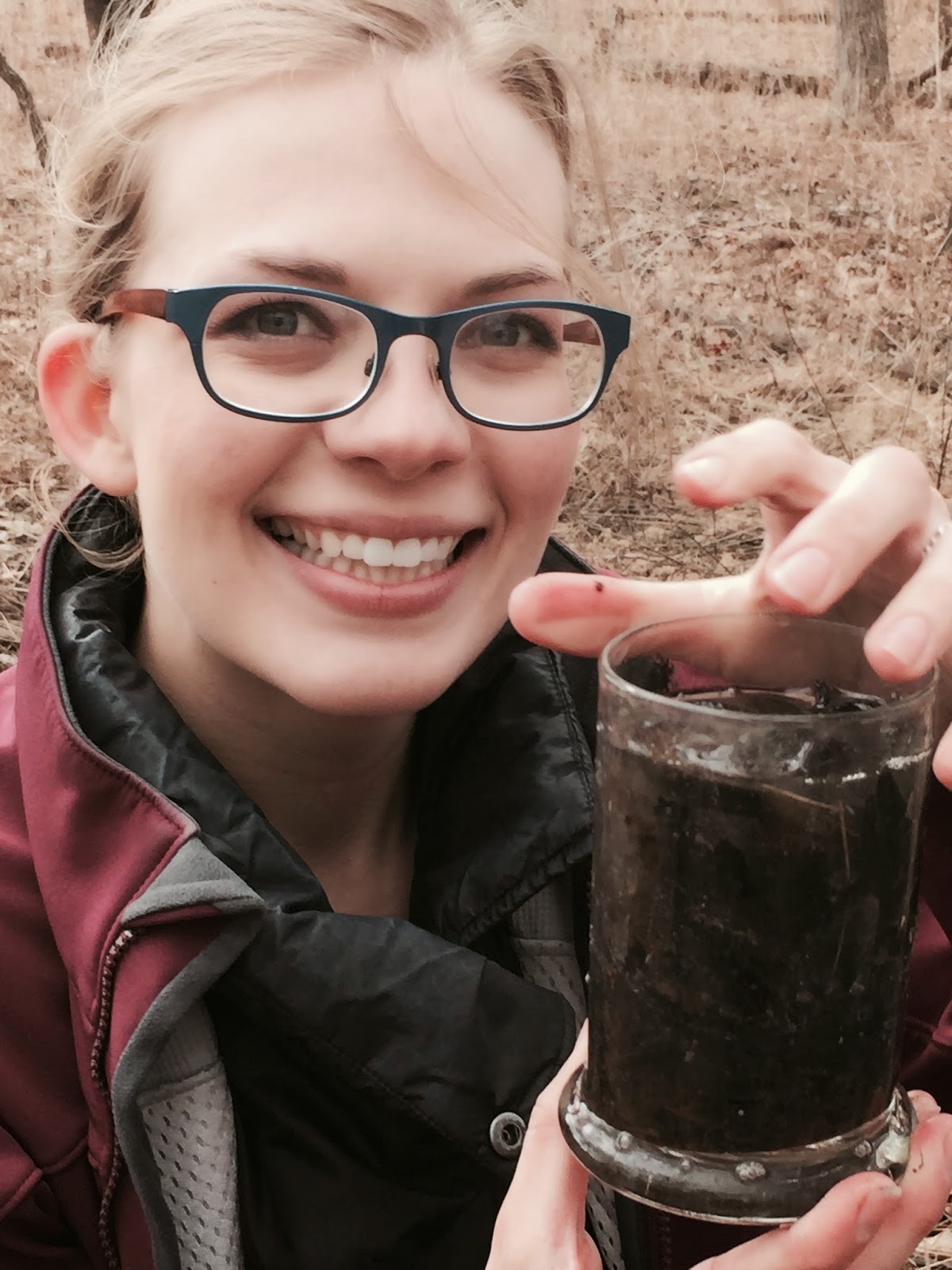
We cruised the parking lot - finding and depositing salted salamanders in glasses of pond water -
then freed the little beings in their pond. 

It was easy for twenty or thirty salamanders to fit in one glass. 
Cecil Hynds-Riddle deserves huge credit for rounding us up and spreading the word on this mission. But her obvious reward is the truly blessed pleasure she clearly gets from helping these little fellow lovers of Somme Woods. 
The Forest Preserve staff arranged for the machine that did some sweeping up yesterday. But the machine broke after only a couple of passes. Now they are in the process of renting another kind of machine that should be able to finish the job. Thanks to Director of Resource Management John McCabe for the quick response.

FORTH UPDATE: March 21. 5:30 PM
Forest Preserve staffer Ron Pitelka brought heavy equipment to sweep up salt. Worked really hard for most of the day. Hard to adjust the machinery right, but in the end he got it. Looks like most of the loose salt is gone. (More details in later summary.) Thank you, Ron!

FIFTH UPDATE: March 22. 5:30 - 6:00 AM
Checked the whole lot. No salamanders. Perhaps too cold to migrate today?

NOTE FROM RON PITELKA: March 22
The comment below was in response to a Facebook post where we Friends of Somme thanked him for his determination and hard work. It is so important that the Forest Preserves (a government agency) have people with heart, competence, and dedication like Ron Pitelka.

Ronnie Pitelka Thanks for all the kind words, Steve! I'm really glad I was able to help today, although I wish there was more I could do. I have to admit, before you showed up, the entire project seemed kinda silly and pointless, as there were no large piles of salt left, just a dusting on the whole lot that seemed insignificant. Once you showed me the dried up critters with the fine grains of salt stuck to them, it really helped me to see what needed to be done. Seeing the pictures on here and reading the blog about this project makes me really happy that I was able to get the sweeper working properly and that I spent the extra time that I did up there today. From an employee's point of view, I feel really bad that this happened. While I don't apply salt for the Forest Preserve, I have operated salt trucks in the past and I can say it's very difficult to actually see how much salt is being deposited, and simply stopping or backing up the salt truck can result in large concentrated deposits. I'm certain whoever salted the lot probably thought they were doing a great job by being so thorough with the salt knowing their work would prevent someone from falling on ice, unfortunately, it really helps illustrate the need for better communication between our departments. While individual goals need to be met, there can sometimes be unforseen and inadvertent consequences to just about any work that is done, especially when the entire picture is not always presented. Hopefully this sort of damage can be prevented in the future by simply not salting this lot, or utilizing an alternative such as sand. Despite the reason for our interaction, it was a pleasure meeting you and learning today! Thanks so much for your and all of the stewards' and volunteers' hard work!!

SIXTH UPDATE: March 23
Many people have suggested flushing the caked salt off the asphalt with lots of water - and explored practical ways to do it. (Part of the problem has been that there was no significant precipitation since the heavy salt 
was applied. Thus salamanders can't get past the concentrated surface salt barrier that separates their winter hibernacula from the breeding ponds.) One problem has been that the only easily-obtainable water available for the purpose is chlorinated hydrant water. Then, today, we finally got a good snowfall. John McCabe asked FP Police and Maintenance to leave the lot closed and not plow it, so the snow can dissolve the salt and wash it away. The snow is already melting and water flowing. Tomorrow we expect good rains. Perhaps this trial is behind us?

SEVENTH UPDATE:  March 25th
After days of sweeping, scraping, and finally a good snow fall and melt, this blue-spotted salamander  seemed to cross the asphalt just fine. We wish it happy and productive mating season in the pond that awaits it.
FOR MORE INFO: check out this Smithsonian article. 

Monday, January 12, 2015

The Grand Narrative of Planetary Restoration


an outline for a book or video

Episode 1. The Earth forms. Life emerges and evolves impressively.  Mass extinctions, botanical marvels. Animal mothers invent tenderness. Gradually our story focuses on what will become a special place. 12,000 years ago, by the side of Glacial Lake Chicago, wooly mammoths, musk oxen, and saber-tooth cats pursue their frosty-breathed and unruly lives. But the planet is warming; glaciers retreat north; musk oxen follow them; and Jefferson’s mammoths, long-horned bison, and other prairie creatures re-invade from the south. Grasslands and oak woodlands form and reform, as they have for 5 million years, moving around the continent in response to climate. But these lands are about to incorporate unexpected newcomers. 


Episode 2. North America connects to Asia, and new species invade including humans, grizzly bear, elk, and wolves. They soon replace the mammoth, mastodon, long-horned bison, short-faced bear, camel, and giant ground sloth. Though the prairies and woods have burned for millions of years, ignition by lightning is now largely replaced by purposeful burning by people as they manage plants and animals for medicine and food. Much of the time, people find life is good. One of the ecologically richest landscapes of the temperate world, the region is a mosaic of human cultures within the woodlands, prairies, wetlands side by side with orchids, passenger pigeons, Carolina parakeets, and white-tailed deer.


Episode 3. Europeans invade across the Atlantic, bringing disease that kills 90% of the native people. Reduced hunting or a while makes space for invasion by the plains bison (never before part of our tallgrass prairie). As Europeans grab land, tribes fight tribes for what's left. The mighty Illiniwek (with their towns of wooden houses) fall to more flexible (and fierce) hunter-gatherers. The tenderness of human mothers sometimes clashes with the harshness of fathers. Some visionary people (Tecumseh, Sojourner Truth, Jane Addams) imagine better worlds. 


Episode 4. As the last Sac, Fox, and Potawatomi retreat north and west, European Americans develop a family farm economy over nearly every acre of the former tallgrass prairie, oak savanna, and woodland. On the edge of the lake, a metropolis emerges through commerce in nature – exhausting first wildlife, then trees, even gradually depleting the rich soil itself. Yet for many new citizens, refugees from stress and misery, life gradually improves.


Episode 5. Jens Jensen, fleeing European wars and injustice, has a vision worthy of the “New World.” The Committee on the Universe (Dwight Perkins, Jane Addams, Frank Lloyd Wright, and others) think up new elements of culture, including the idea of saving natural landscapes and playgrounds as a part of nature’s metropolis. Friends of Our Native Landscape and the Prairie Club form to campaign for the new vision. 15 years of legal and social battles lead finally to victory as the world’s first metropolitan Forest Preserve is born. Its charter: 

“ … to acquire and hold land for the purpose of protecting and preserving the flora, fauna, and scenic beauties ... and to restore and restock, protect and preserve the natural forests and such lands together with their flora and fauna as nearly as may be, in their natural state and condition, for the purpose of the education, pleasure and recreation of the public.”


Episode 6. Advocates search for the most rich and beautiful land, and the Forest Preserve buys it. People work to maintain nature traditions from the Native Americans, European American farmers, and the customs of immigrants. Preserve managers plant trees, mow scenic meadows, hold festivals. Cap Sauers rescues the institution from corruption and makes peace with the politicians. He helps George Fell found the Illinois Nature Preserves Commission with its enlightened vision of biodiversity conservation. Cook County Forest Preserves dedicate 11 of the state’s first twelve nature preserves including Shoe Factory Road Prairie, Busse Woods, Cranberry Slough, and the pathetically-named Thornton-Lansing Road Nature Preserve, a complex of savanna, prairie, wetland, and woodland. 


Episode 7. Henry Cowles of the University of Chicago, studying Lake Michigan dunes, helps develop the concept of the ecosystem. Roberts Mann (FPD staff leader) and Aldo Leopold (University of Wisconsin) teach, write papers, and exchange correspondence about what forest preserves can be. “Mushroom Fests” appeal to middle-European foragers. Performances, pageants, dances, and picnics draw millions of people to the preserves (on their one day off each week). The FPD explores restoration of deer, turkeys, and prairie chickens. May Theilgaard Watts writes “Reading the Landscape” to engage people with local prairies, ravines, bogs, and nature generally. Learning that the ‘Chicago vision’ is lacking elsewhere, she then writes “Reading the Landscape of America” and later “… of Europe.” But imperceptibly, much of what’s appreciated in the forest preserves is slipping away.


Episode 8. Leopold and other University of Wisconsin biologists invent prairie restoration – the world’s first ‘ecosystem medicine.’ Dr. Robert Betz a biochemist at Northeastern Illinois University in his free time wages a personal campaign to discover, preserve, and restore the region’s remnant prairies. Betz, Ray Schulenburg (Morton Arboretum) and Dot and Doug Wade (NIU) educate scores of activist volunteers who hold conferences and look for prairie conservation opportunities. Illinoian George Fell, founder of The Nature Conservancy (not-for-profit) and Illinois Nature Preserves Commission (partly government), help launch another planetary first, the Illinois Natural Areas Inventory, which searches the entire state and finds that nature survives in only 610 remnants – pitifully representing only 7/100th of 1% of the state. Indiana and Iowa turn out to be the same. The soils and biodiversity of the corn belt represent crucial opportunity and importance for human nutrition and health, and we just let it go? Yet more rich survives here than in eastern states or California, which had been exploited for centuries longer. Thus, planetary recovery starts here. 


Episode 9. Inspired by Leopold, Betz and Fell, a group of volunteers wins approval to restore vanishing prairies on public land. The North Branch Restoration Project engages scores of neighbors in the mission (with the spirit of ‘the sixties’ and emerging environmentalism). Rare and endangered plants and animals respond with drama and beauty. Betz spurs them on, saying that “people like you and me need to act on the ideas that the ‘properly educated’ academics can’t have.” “Unproven” ideas start to save what’s been vanishing so fast. After a mere decade of hard work and stunning successes, the group is widely celebrated as the first community for ecosystem restoration on public conservation land. First acres, then tens of acres, then hundreds recover biodiversity.


Episode 10. The drama proceeds despite many reversals. George Fell and the entire Nature Preserve entire staff are fired by Illinois. Too non-compromising. With nowhere else to turn, the Illinois Nature Preserves Commission reluctantly approves a volunteer program modeled after the North Branch Prairie Project for the state’s nature preserves. The Nature Conservancy hires the former INPC field staff and develops the Volunteer Stewardship Network into a national and international model. Power grows, and with it, foes. Fifteen years into the ‘experiment’ the press and many public officials turn on the program – but that drama will mostly have to wait until Episode 12.


Episode 11. While restoration for prairies is increasingly expert, the region’s oak savannas and woodlands continue to degrade as the prairies once did. To get approval to burn the forests means overcoming decades of misleading education. A rough consensus slowly emerges that forests and wetlands too desperately need restoration to cope with modern stresses if their species are to survive. Trained expert volunteers cut great swaths of invasive brush and provide much needed controlled burns to more than 100 prairies, woodlands, and wetlands in the greater Chicago region. Conservation agencies begin hiring restoration staff. Some volunteers launch entrepreneurial companies to satisfy increasing demand for ‘ecosystem medics.’ 


Episode 12. The new conservation community (paid and volunteer stewards) becomes increasingly numerous, sophisticated, and respected. But at the same time, preserve land is appropriated by politicians for garbage dumps, a sports stadium, and, if a powerful pol has his way, a neon-lighted gambling casino. Most stewards had tried to stay out of politics, but the casino was too much. Recognizing the need for broader public support and to engage the region’s powerful cultural and scientific institutions, the Nature Conservancy launches “Chicago Wilderness” – a campaign to gain resources and recognition (with tens, then hundreds of organizational partners). Just as Chicago Wilderness is launched, a ferocious media campaign attacks the Conservancy, many individual stewards, and Forest Preserve conservation staff. DuPage, Lake, and Cook Counties take the most heat. Cook FPD President John Stroger declares a “moratorium” that ends all forms or restoration (and even litter clean-up and kids educational activities) at the District’s natural areas. A similar moratorium in DuPage County lasts for months, but in Cook it drags on for years because of complex politics.


Episode 13. Looking for an organizational home with reputation for both good conservation science and committed advocacy, stewards seek support from the National Audubon Society. Soon Audubon is hiring the interns, sponsoring the educational conferences, and recruiting the new volunteer groups. For some years, Audubon houses Chicago Wilderness Magazine and the new Friends of the Forest Preserves. Building support from the ground up, stewards gradually resume their ‘controversial’ work: cutting trees, culling deer (professionals mostly in the urban area), applying herbicide, and controlled burns. The new projects span thousands of acres.


Episode 14. This episode predicts the next few decades in Chicago Wilderness. The Cook County Forest Preserves board and Great Foundations decide to fund the Next Century Plan (approved in 2014): 30,000 acres to be restored to high quality, millions of people engaged in nature, 400 volunteer stewards empowered, and much more. Not that we can truly predict even a few years ahead – but we start thinking generations ahead. We are humans; we can do it. Just as people have developed passionate interest in dancing – sports – cars – gardening: so now in their free time citizen-scientist stewards work closely (and distantly) with professionals to develop dramatic advances in sustainable living, solutions to pollution, climate change, and other as-yet-unexpected challenges. Chicago becomes a “Silicon Valley” for ecosystem restoration on larger and larger scales. 


Episode 15. “Natural disasters” in the year 2050 force humanity finally to face the fact that it has just two choices: One – take planetary health seriously and employ a level of resources formerly devoted only to war. Or two – accept that most life on the planet including us will soon spiral out of existence. You’ll be glad to know that, with ferocious commitment, creativity, and a bit of good luck, the planet is rescued. We thank ecosystem medicine that started with “A Land Ethic” and “to restore, restock, preserve and protect.” Because there was never enough money to do the quirky science that leads to fundamental breakthroughs, “classic unfunded science pioneers” make some of the key discoveries. Yes, true, the professional scientists, government workers, and entrepreneurs contribute much – partly because of increased demand and resources (ultimately coming from the community of stewards and earth-lovers). The Chicago conservationists play a major role in saving the planet. We built the constituency and thereby found the resources. Professionals, citizen scientists, and artists pull it all together and work miracles. 


Friday, November 07, 2014

Unexpected Big-ass "Forest Fire"

It was becoming a beautiful day. The prediction had been for damp and cold, but the actual weather looked increasingly great. An alert went out to the new Somme East stewards. "Anyone free to do some planning, exploration, and loving the ecosystem, before the cold comes?"

Part of our thinking was that it might be the perfect day to find and mark (and protect from slaughter) a beautiful little grove of black haw trees and shrubs. This could be important, because the new mission of our new community (which we consider calling "Somme 2030" or the "Somme Revival Party") was to restore 150 acres of rare oak woodland and wetland habitat, and many efforts fail when it comes to the plum trees (Prunus americana), hazelnuts (Corylus americana), and black haws (Viburnum prunifolium), occasional patches of which may have been a crucial part of the habitat.

Would anyone be free at the last minute? It turns out that Travis had already scheduled a day off - and both Michael and Josh managed to wiggle out of whatever, and now we four assembled in the wilderness of Somme East to plan the future.

We weren't expecting drama today. Josh, Michael, Travis and I searched for seedlings
of rare understory trees that might become important habitat by the year 2030. 

Why do haw, plum, and hazelnut need help? First, because they've been nearly obliterated by the shade of invasive trees (from buckthorn to maple) that - in the absence of fire - destroy the richness of the oak woodlands. Second, because now that we're starting to restore the habitat, our controlled burns will also unfortunately kill the few native shrubs that survive. And last, because eager-to-be-helpful brush cutters will snip them if they're not marked, when they cut the buckthorn.


Oh, they may not look like much now, but the color of those two surviving leaves give away a patch of one- to four-foot-tall black haw sprouts, scattered over an area the size of a house. If protected, this shrub thicket could be twenty feet tall by 2030. It could bear the nests of blue-winged warblers, eastern towhees, black-billed cuckoos and other now-rare birds that once helped the woods to thrive.

The blue-black fruits 
of the haw (on their bright red stems) would once again be eagerly devoured, in the words of Donald Culross Peattie, by "gray foxes, white-tailed deer, bobwhites, wood-wandering boys, and botanists." (But why do wood-wandering girls 
get left out?)


When we'd find a patch of black haw, we'd record the location on cell phone GPS, tie ribbons on the young trunks (so lopper-wielding brush cutters could avoid them) and rake leaves away - because - we hoped - if all went well - this whole area would soon be treated to a prescribed burn by Forest Preserve staff or contractors. 

Did we really think that would happen? Sure, we'd made the request earlier this fall. Forest preserve restoration has indeed been getting better and better. But we've also been disappointed. And this large area has never been burned since the days of the bison and the Potawatomi. 

That's when the miracle happened. We were intent, focused, thinking through plans, tying ribbons, raking leaves - and having a harder and harder time hearing each other's voices - because distant trucks or trains or some ungodly noise was getting louder and louder. Suddenly Travis said, "Leaf blower!"

Really? Out in the middle of the forest? Two of us immediately knew what that meant. Staff were making fire breaks, right where we'd hoped. At first we assumed the breaks were being prepared for another day. But then we saw growing billows of smoke. What serendipity! It was happening now!

Before we knew it, we were being treated to the drama of a Forest Preserve on fire. 

Many people might think perhaps we'd be scared. But a woods fire on a calm day like this moves at the speed of a very ill patient with a walker. The average person could crawl out of the way. You could hop over it. You could walk through it, stepping briefly right in the flames for that matter, if you were wearing clothes and footwear not made of petroleum. Not that anyone would recommend it. But the level of danger is trivial. Don't lie down in the flames, and you're okay. (On the other hand, don't try the "walking through fire" trick with "synthetics." Some melt. Some burn.)

How about the worry that the fire will "get out of control" and burn down buildings? Here we can first look at the record. All the region's conservation agencies burn their prairies and oak woods, and no fire has escaped to burn down buildings. The reasons are simple. Competence and firebreaks.

Before the burn was lit, those leaf blowers emptied a narrow strip of soil of any flammable leaves, wood, or anything else.
In the photo on the left you can barely see the leaf-blown area to the right of the black. But look how effective it was.

It works because the person spreading the fire starts it right on that edge, and other crew with water backpack pumps are carefully watching to make sure no hint of flame tries to sneak across.

Once the fire has burned a few feet in, leaving behind a black area of no fuel, the woods outside the break are safe.

Notice the little flames moving left in the photo. The farther they get, the safer the area outside the break.

(On the other hand, "don't try this at home." There are many dangers that are not obvious to the untrained. Only people with extensive training and expertise can do controlled burns.)

Perhaps this is the time to consider the "cost" or "harm" of such a fire - compared to the benefits. People with respiratory problems should stay out of the smoke, but they could just walk away. Air pollution is indeed a cost. We'd all prefer no air pollution, but we degrade the air by driving our cars (or taking the bus or train). We increase carbon dioxide in the atmosphere every time we breathe. We put particulates in the air every time we have a cook-out or burn a fire in a fireplace. We as a culture have decided that some benefits outweigh some costs.

In this case, the benefits accrue to ecosystem services performed for the planet by healthy woods, and biodiversity conservation, and recreation. It used to be that the natural lands of the Cook County Forest Preserves were treasured for recreation by hikers, artists, photographers, birders, foragers, and kids of all ages. It used to be that these 55,000 acres cleaned our urban air throughout the growing season ("the lungs of the city"). It used to be that the ecosystem preserved the soil from erosion and sponged up rain to mitigate floods.

Insidiously, "invasive" or "malignant" species began progressively to destroy all these values. Only in recent decades have we gradually come to understand that an impenetrable thorn thicket where an open woodland used to be was not "nature" or "natural" or good. Fire restores the plant community, animal habitat, and ecosystem services.

Small buckthorns (the nasty saplings here with green leaves) bite the dust.

The most obvious benefit is the control of buckthorn. This small tree - in the absence of fire - destroys animal habitat and shades out the grasses and wildflowers so severely that even the soil erodes off and clogs streams, lakes, and ultimately the Gulf of Mexico. After this fire, not only will the buckthorn be reduced, but the thick mat of leaves will uncover the soil just long enough to seed. Right away Travis, Michael, Josh and the rest of the Somme Revival Party will plant the rare seeds they've been gathering all summer and fall. Next spring they'll sprout in perfect conditions. Healing has begun.

If you checked out the Somme Facebook page, you might have seen the video of this fire in which 
burn boss Evan Barker seems to be walking through the woods spreading fire at random. That too deserves comment.

Carefully placed strip fires do what was once done by a mighty wind. 

For millions of years, grasslands and oak woodlands burned from fires ignited by lightning. Most of the grasses, leaves, and dead trees were then burned by fires spreading with the wind on the very driest, hottest, windiest days. Considering how slowly today's tamer fires are spreading, large areas like Somme east (150 acres) would have to burn for days if a single fire were to spread slowly on its own. So a drip torch is used to start new lines of flame, back and forth through all the key areas. This fire will spread out in both directions, burning the leaf litter (and many invasives) from the entire area of this photo in ten or fifteen minutes.

Wonderful day. Now we approach the future with greater hope and confidence.

Oak woodland in Somme Prairie Grove after decades of restoration.

What comes next? First finish gathering, and then broadcasting, all that crucial seed.
Then cutting bigger brush and burning it in bonfires throughout the cold winter.
Then more study, planning, and month to month of rewarding stewardship in the beautiful and recovering Somme Woods (inspired in part by the pilot work to the west in Somme Prairie Grove).
A worthy, wonderful, and generous dream.
Somme's animals and plants somehow certainly appreciate this noble quest. 

For a 2017 report on how this mission proceeds, click here, here, or here.

For later updates on this group and mission, click here,