I woke, as if from a dream (a bad dream). When I saw the photos, I doubted by eyes. The images and plant list suggested a far richer woodland than I’d ever seen - but which I had long looked for, far and wide.
But Yikes! It had recently been bulldozed, in part. Yet – more important – the treasure mostly still existed in this world. Botanist Dan Carter called the site "jaw-droopingly intact." Conservationist Eriko Kojima, on seeing it for the first time, was so blown-away she declared that she "wouldn't sleep for a week."
Oak woods had seemed dull. Compared to prairies, savannas, or fens – these days the woods excite few natural areas conservationists. The word biodiversity is currently hot; it invokes the tropical rain forest, the prairie white-fringed orchid, coral reefs - but not woods.
For context, consider the re-discovery of the prairies and savannas. Only in recent decades did prairie impinge on public consciousness, when John Curtis, Aldo Leopold, May Watts, Robert Betz and a few others opened our eyes. (See Endnote 1: The Re-discovery of Nature.) Now we know that original prairie remnants are extremely rare and rich. If you’ve never had the experience, it’s worth learning to identify the plants and to perceive the structure so you can truly see one. An original prairie is strikingly superior in plant and animal biodiversity to degraded remnants or restorations. We’re learning to care for and expand remnants, but a reconstruction is nothing like an original.
The discovery of the savanna was unexpected and yet more recent. Even in the 1970s, the Illinois Natural Areas Inventory essentially didn't find them, in part because they're rarer than the prairies and in part because no one had yet learned what to look for. (A good start at belatedly recognizing the savanna emerged from the 1994 North American Conference on Savannas and Barrens.)
But now for true remnant woodlands. Did woods of high quality still exist - especially bur oak woods, the tree that requires the most sun, according to Curtis? Can we study them only through restoration? But now the "discovery" and recognition of the quality of the little bur and white oak Army Lake site goes down into history? How big a discovery is it?
Individual endangered species have the advantage of being somewhat protected by laws, regulations, and standard practices. But – rarer and more important – a very high quality woodland ecosystem is not so protected. (See Endnote 2. Learning from Army Lake.)
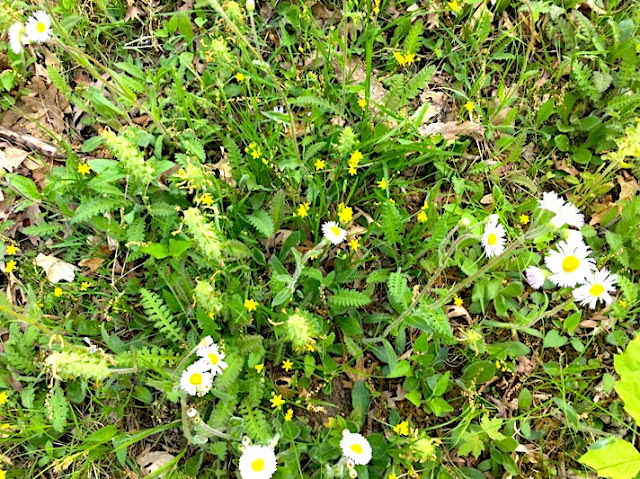 |
One of the photos that seemed marvelously rich for a woodland. Largely high-quality and rare plants make up this turf, including yellow star-grass, robin’s-plantain, forked aster, wood pea, veiny pea, wood betony, low false bindweed, sky-blue aster, wood rush, Penn sedge, running savanna sedge, and blue-eyed grass.
(2016 photo by Dan Carter) |
Most woodlands today, if they have any quality at all, impress people who care by their dense displays of common spring ephemeral flora. In contrast, Army Lake Woodland has a dense, diverse, rare flora throughout spring, summer, and fall. That it's principally not ephemeral. Because of grazing or excessive shade at some point, most woodlands have lost most high-quality plants - especially those of summer and fall - as well as the other biota (animals, fungi, bacteria, etc.) associated with them. (See Endnote 3.)
Few heard of Dan's 2016 discovery the time. Further documentation and analysis was needed. People are busy. The site was supposedly secure in the ownership of the Wisconsin Department of Natural Resources (WDNR). But then came the bulldozers.
“A gut punch ... a failure ... a hill worth dying on.”
I personally heard about the site in 2022 when Christos Economou sent me a link to a remarkable 2020 blog post by the perceptive Dan Carter. I didn't know the man. Later, in response to inquiries, Dan expressed two regrets: 1) as a scientist, he regretted that he wrote that post when he was emotional with anger at the destruction; 2) as a person, he wished he'd been more outspoken in defending the site from development, though it would likely have cost him his job. Many eco-experts work for public agencies, or otherwise get funded by them, or just need to cooperate with them. They speak calmly. When the damage came, it was worse than Dan or his colleagues expected. Dan called it "a gut punch." In retrospect a battle to save this woods would have been "a hill worth dying on." (See Endnote 4: Politics.)
Central to what makes a Grade A prairie remnant striking is the density and diversity of rare plants. When Dan Carter was asked to evaluate Army Lake Woodland as a potential site for a boat launch, he found a woodland as rich as a remnant prairie. (See Endnote 5. Plant Species List.) The plants are important in themselves, but they're also the best indicators of full biodiversity that includes the invertebrates, fungi, bacteria and other biota that are principally associated with true, rich remnants because those organisms rely on the plants. .
Army Lake Woodland had a substantially more diverse and high-quality woodland community than is known anywhere else in southeastern Wisconsin (perhaps anywhere in Wisconsin or northern Illinois?). So, how could it get bulldozed by a conservation agency, when that boat launch could have been put on many other spots on the shore of Army Lake? Recommendations were not followed. Insufficient advocacy and public concern emerged. About a third of this best woodland remnant was destroyed. That's the bad part. But, again, two-thirds of this gem and quite a bit more restorable remnant still exist.
Next Steps
In the conservation of small remnants, there are typically three values and associated goals:
1. Save, restore, and study what's there.
2. Expand the size of the remnant, if possible, as small plant and animal populations are vulnerable.
3. Use seed and knowledge to restore larger areas.
1. Save, restore, and study
An anticipated program of restoration management is crucial, as increasing shade and invasives threaten more and more quality. The site has to date received no invasives control and no prescribed burns. WDNR staff resources are stretched thin and deserve higher appropriations. But volunteer stewards could carry a lot of the load on this small site, if properly facilitated and empowered. Needed stewardship would likely lead to additional species emerging, knowledge, and insights.
2. Expand
The high-quality remnant biota could be restored into poorer-quality adjacent areas. A first step that could start any time would be invasives control. Crown vetch has recently been discovered along the boat launch access road. Many dangerous invasives are there in small numbers. They should go soon. Some native species now cast damaging amounts of shade, in the absence of fire. Regular controlled burns are a must. Many managers would recommend annual burns of half or more of such a site, at least while it's in the "intensive care ward" stage.
3. Use seed and knowledge to restore larger areas.
Can-do management and restoration of Army Lake Woodland would benefit other nearby remnants (and needy oak woodlands throughout the midwest), in part by what could be learned here in the next few years. Also, many nearby areas would benefit from seed from Army Lake, especially once it has recovered overall quality.
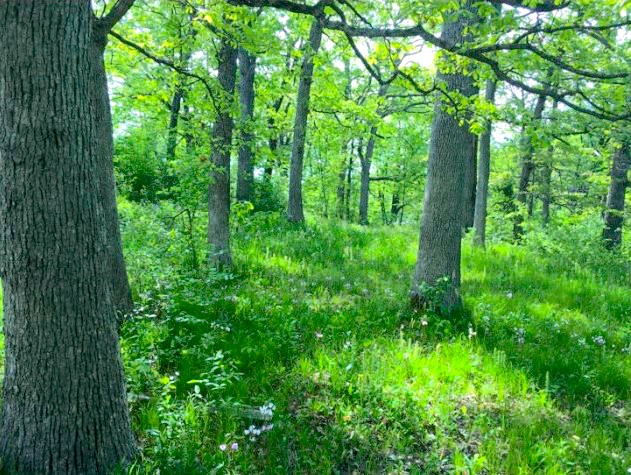 Most of the diversity on the island survives where over-growth by brush has been limited, perhaps due to the intense competition of diverse grasses and wildflowers.
If you’re tempted to take a look at this site, I don’t blame you. But please don’t trample such a tiny, vulnerable, precious remnant. You can pretty well observe what’s important through the fence (that was erected to protect it from boat launch and beach traffic) and on the unfenced half of the island. If you have a serious reason to study the flora and can’t restrain yourself from slipping through the fence, a little fishermen’s trail runs from the fence to the east side of the island. Perhaps some people could walk carefully on that?
Additional views of the rich flora of Army Lake Woodland are below:
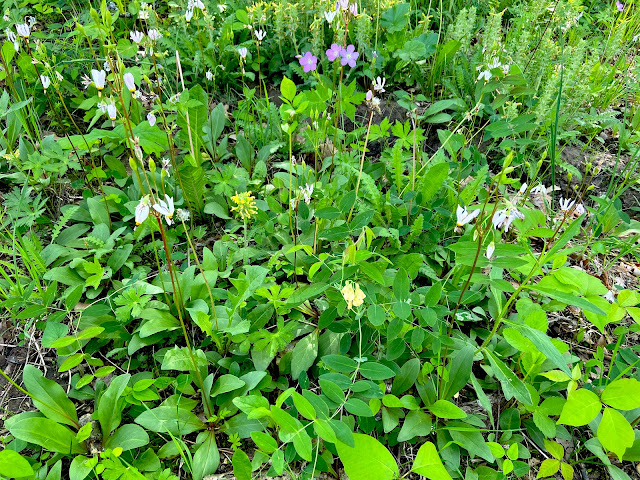 Blooming in the center of this photo is the formerly common pale vetchling with its cream-colored blossoms. Also in bloom here are wood betony (yellow), shooting star (white), and wild geranium (pink).
In bloom, Carolina vetch, blue-eyed grass, and wood rush. In bud: false dandelion. Prominent foliage: shooting star, bastard toadflax, and wood betony.
Blooming: yellow star-grass and robin’s-plantain. In bud upper right: Maryland sanicle. Identifiable by their foliage: bastard toadflax, woodland milkweed, NewJersey tea, northern hawkweed, showy goldenrod, white lettuce, false Solomon’s-seal, sedges, a white oak seedling, and bracken fern.
Note on bracken and soils: Many ecologists these days expect bracken on sandy soils, but Army Lake Woodland soil, where exposed by bulldozing, is not sandy. Sand savannas and woodland remnants are much more common than on rich soils, perhaps because invasives take over more slowly there. Soils exposed by the bulldozing at Army Lake are not sandy. The biodiversity of rich soils survived here for other reasons.
Viewed through the fence that now somewhat protects the woods: alumroot, shooting star, blue-eyed grass, wild geranium, and pale vetchling. In seed on right is common dandelion; it's here because the site gets random trampling stress, which should be minimized.
Endnotes
Endnote 1. What is original nature?
For most of human history, the concept of "nature" was a foggy one, at best. More often nature was something poets said "Oh my!" about in flowery language. More recently, as real nature was slipping away, it needed to be understood and defined.
The seminal Illinois Natural Area Inventory (INAI) of the 1970s was considered by many the most authoritative theoretical and practical approach to defining and conserving true nature in its various forms. Soon, as a result, Illinois protected most of its surviving high quality prairie remnants. They were priceless ecological heritage that had gone unrecognized in part because it had long vanished from productive lands over most of the U.S. and, arguably, the human-occupied world. But the Inventory did much less well on the fire-dependent oak communities. In the 1980s, conservationists figured out how to recognize savanna remnants and begin restoring them to high quality. Only in 2011 did oak woodlands get formally recognized as a category separate from maple forest. Conservation and restoration of oak woodlands is much less advanced than for prairies and savannas.
Like Illinois, Wisconsin has been in the forefront of natural areas conservation, thanks to John Curtis, Aldo Leopold, The Prairie Enthusiasts, and strong communities of professional and volunteer conservationists. As with the savannas in Illinois, the long overdue discovery of Army Lake Woodland provides insights that suggest how to similarly upgrade biodiversity conservation for oak woods - quality recognition, prioritization, and restoration.
Endnote 2. Learning from Army Lake
This site is now being used by the Wisconsin Department of Natural Resources and others to develop new oak woodland assessment tools. This blog hopes to report on that effort and other Army lake learning, when there's something to report.
Braving a light rain in June 2022, participants in improving tools for woodland evaluation included, clockwise from the foreground (back view, in red) Ryan O’Conner (Inventory Coordinator, WDNR), Dan Carter (The Prairie Enthusiasts), Brian Miner (Southeast Wisconsin Land Steward, The Nature Conservancy), Matt Zine (Habitat and Management Specialist, WDNR), and Pete Duerkop (District Ecologist, WDNR).
Endnote 3. Why does this tiny gem still exist?
The site is only about 1.6 acres and was formerly a semi-island. If this find is as important as it seems, the likely reason is that a tamarack swamp separated it from adjacent uplands, and for that reason it escaped the heavy grazing that degraded the biodiversity of most woodlands. The intervening marsh is narrow enough and flammable enough that prehistoric fires could well have spread across or jumped it. But the site has not been known to burn in recent years. The dense diversity may have helped slow the invasion by brush. Higher-quality natural area are somewhat more resistant to invasion by species that would degrade them.
Endnote 4: PoliticsBoth professionals and volunteers struggle with the balance between saying too much (thus making enemies) and saying too little (thus being ignored). When Dan Carter assessed Army Lake Woods for the boat launch, his job was with the Southeastern Wisconsin Regional Planning Commission. In his later post on what happened, he wrote:
"I contacted some local stakeholders and advised them of a public meeting (listening session or some such thing) about the launch, warning about potential impacts to something precious and irreplaceable, and I promptly got an upset phone call from the property manager (though I appreciate him not going straight over my head like the Milwaukee County Parks Natural Areas Coordinator did a few years later). In hindsight, I kind of wish he had called my boss. It might have freed me up to more strongly oppose what was about to happen."
"What happened at Army Lake wasn’t just wrong, it was insane. Really, the forked aster was the only thing there with protected status that might have helped it, but that’s also insane, because communities support rare species; it’s not the other way around."
As Dan points out, the kind of public support that might have made the stakes clearer to decision makers – perhaps to a point that Dan would not have felt his job in jeopardy – was lacking. A strong constituency for Army Lake Woods’ biodiversity might, in fact, have allowed conservationists to feel empowered to look for creative potential solutions. A key question is, how do we caring conservationists build such constituency? Public agencies are necessarily political. That's not a bad thing. "Politics" is another way of saying "democracy." Compromises and trade-offs have to be made. In challenging cases, the responsibility lies not just on the agency employees but on the whole conservation community. At one point decades ago, the entire Illinois Nature Preserves Commission staff got fired (its budget zeroed out) in part because of failures to compromise. A wise and valiant participant in that struggle, Jerry Paulson, the day-to-day director at that time, wrote a comment on this post (see below) that ended: "Public employees who speak-up to protect nature are true heroes! But, they can't be expected to do it all alone. Every state needs a Friends of Illinois Nature Preserves or The Prairie Enthusiasts to advocate for nature."
Endnote 5: Army Lake Woodland Plant List
Assembled by Dan Carter as part of a "timed meander" assessment. According to the rules of this exercise, the list includes all the plants that can be identified in a brief survey; the investigator stops when they fail to find a new species in five minutes. There are likely many other species present. (A few additional common names were added for this post.)
| |
Acer saccharum | hard maple, sugar maple (an invader?) |
Agrimonia gryposepala | common agrimony, tall hairy agrimony |
Amelanchier laevis | Allegheny serviceberry, Allegheny shadblow |
Amphicarpaea bracteata | American hog-peanut, hog-peanut |
Anemone americana | round-lobed hepatica |
Anemone quinquefolia | nightcaps, wood anemone |
Antennaria parlinii | Parlin's pussy-toes, plantain pussy-toes |
Apocynum cannabinum | hemp-dogbane, Indian hemp |
Aquilegia canadensis | Canadian columbine, red columbine, wild columbine |
Aralia nudicaulis | wild sarsaparilla |
Asclepias exaltata | poke milkweed, tall milkweed |
Aureolaria grandiflora | large-flowered yellow false foxglove |
Berberis thunbergii | Japanese barberry (an invader) |
Calystegia spithamaea | low bindweed, low false bindweed |
Carduus nutans | musk thistle, nodding thistle (an invader) |
Carex cephalophora | oval-headed sedge, short-headed bracted sedge |
Carex pensylvanica | common oak sedge, Pennsylvania sedge |
Carex siccata | dry-spiked sedge, hay sedge, hillside sedge, running savanna sedge |
Carex stricta | tussock sedge |
Carya ovata | shagbark hickory, shellbark hickory |
Ceanothus americanus | New Jersey tea, red-root |
Celastrus scandens | American bittersweet, climbing bittersweet |
Cerastium fontanum | common mouse-ear chickweed (an invader) |
Comandra umbellata | bastard-toadflax, false toadflax |
Cornus foemina | gray dogwood, northern swamp dogwood, panicled dogwood |
Cornus rugosa | round-leaved dogwood |
Cornus sericea | red osier dogwood |
Dactylis glomerata | orchard grass (an invader) |
Danthonia spicata | poverty danthonia, poverty grass, poverty oat grass |
Diervilla lonicera | northern bush-honeysuckle |
Elaeagnus umbellata | autumn olive (an invader) |
Equisetum arvense | common horsetail, field horsetail |
Erigeron pulchellus | Robin's-plantain |
Euphorbia corollata | flowering spurge |
Eurybia furcata | forked aster |
Festuca saximontana | Rocky Mountain fescue |
Fragaria virginiana | thick-leaved wild strawberry, Virginia strawberry, |
Frangula alnus | European alder buckthorn, glossy buckthorn |
Fraxinus americana | white ash (an invader?) |
Galium boreale | northern bedstraw |
Galium concinnum | pretty bedstraw, shining bedstraw |
Gaylussacia baccata | Huckleberry |
Gentianella quinquefolia | ague-weed, stiff gentian |
Geranium maculatum | Crane's-bill, spotted geranium, wild geranium |
Helianthus hirsutus | hairy sunflower, oblong sunflower, rough sunflower |
Heuchera richardsonii | prairie alumroot, Richardson's alumroot |
Hieracium caespitosum | field hawkweed, yellow king-devil (an invader) |
Hieracium umbellatum | narrow-leaved hawkweed, northern hawkweed |
Ilex verticillata | common winterberry |
Juniperus virginiana | eastern red-cedar (an invader?) |
Krigia biflora | false-dandelion, orange dwarf-dandelion, two-flowered Cynthia |
Lactuca canadensis | Canada lettuce, tall lettuce, tall wild lettuce, w |
Larix laricina | larch, tamarack |
Lathyrus ochroleucus | cream pea-vine, pale vetchling, white pea |
Lathyrus venosus | veiny pea |
Lonicera dioica | limber honeysuckle, mountain honeysuckle, red hone |
Lonicera X bella | Bell's honeysuckle, showy bush honeysuckle (an invader) |
Luzula multiflora | common wood rush |
Maianthemum racemosum | false Solomon's-seal, false spikenard, large false Solomon's-seal |
Medicago lupulina | black medick (an invader) |
Melilotus albus | white sweet-clover (an invader) |
Melilotus officinalis | yellow sweet-clover (an invader) |
Ostrya virginiana | eastern hop-hornbeam, ironwood (an invader?) |
Parthenocissus inserta | grape woodbine |
Pedicularis canadensis | Canadian lousewort, forest lousewort, wood-betony |
Phryma leptostachya | American lop-seed |
Picea glauca | white spruce |
Plantago major | broad-leaved plantain, common plantain (an invader) |
Poa compressa | Canada bluegrass, wiregrass (an invader) |
Podophyllum peltatum | May-apple, wild mandrake |
Polemonium reptans | Greek-valerian, spreading Jacob's-ladder |
Populus grandidentata | big-tooth aspen, large-toothed aspen |
Potentilla simplex | common cinquefoil, old-field five-fingers |
Prenanthes alba | lion's-foot, rattlesnake-root, white-lettuce |
Primula meadia | eastern shooting-star, pride-of-Ohio |
Prunus serotina | wild black cherry |
Prunus virginiana | chokecherry |
Pteridium aquilinum | bracken, bracken fern |
Quercus alba | white oak |
Quercus rubra | northern red oak |
Ranunculus abortivus | little-leaf buttercup, small-flowered buttercup |
Ranunculus fascicularis | early buttercup, thick-root buttercup |
Rhamnus cathartica | common buckthorn, European buckthorn (an invader) |
Rosa carolina | Carolina rose, pasture rose |
Rosa multiflora | multiflora rose (an invader) |
Sanicula marilandica | black snakeroot, Maryland sanicle |
Sisyrinchium albidum | common blue-eyed grass |
Solidago speciosa | showy goldenrod |
Solidago ulmifolia | elm-leaved goldenrod |
Symphyotrichum laeve | smooth blue aster |
Symphyotrichum oolentangiense | sky-blue aster |
Symphyotrichum urophyllum | arrow-leaved aster, white arrowleaf aster |
Taraxacum officinale | common dandelion (an invader) |
Toxicodendron rydbergii | Rydberg's poison-ivy, western poison-ivy (an invader?) |
Trifolium pratense | red clover (an invader) |
Vaccinium myrtilloides | velvet-leaved blueberry |
Viburnum opulus | European cranberry-bush (an invader)
|
Viburnum rafinesquianum | arrow-wood, downy arrow-wood |
Vicia caroliniana | Carolina vetch, pale vetch, wood vetch |
Viola sororia | door-yard violet, common blue violet, hairy wood violet |
Vitis riparia | frost grape, river bank grape |
More references, if you're interested
In that presentation, Dan offers the summary below from Veldman et al. It summarizes characteristics of ancient grassland ecosystems from a paper that focuses principally on the tropics. But it offers principles that may apply to our less-well-studied remnants as well.
Three of the many posts on this blog that explore similar questions in Illinois remnants and restoration:
A similar but more objective account of Army Lake Woods - with some additional information - can be found here.
Acknowledgements
This post was written by Stephen Packard. Credit for the original discovery of the significance of Army Lake Woodland goes to Dan Carter. Dan is now with The Prairie Enthusiasts, a highly-respected organization that focuses volunteer and professional resources on stewardship and advocacy for biodiversity.
Thanks for proofing and edits: to an early version to Dan Carter, and for this version to Matt Evans and Christos Economou.

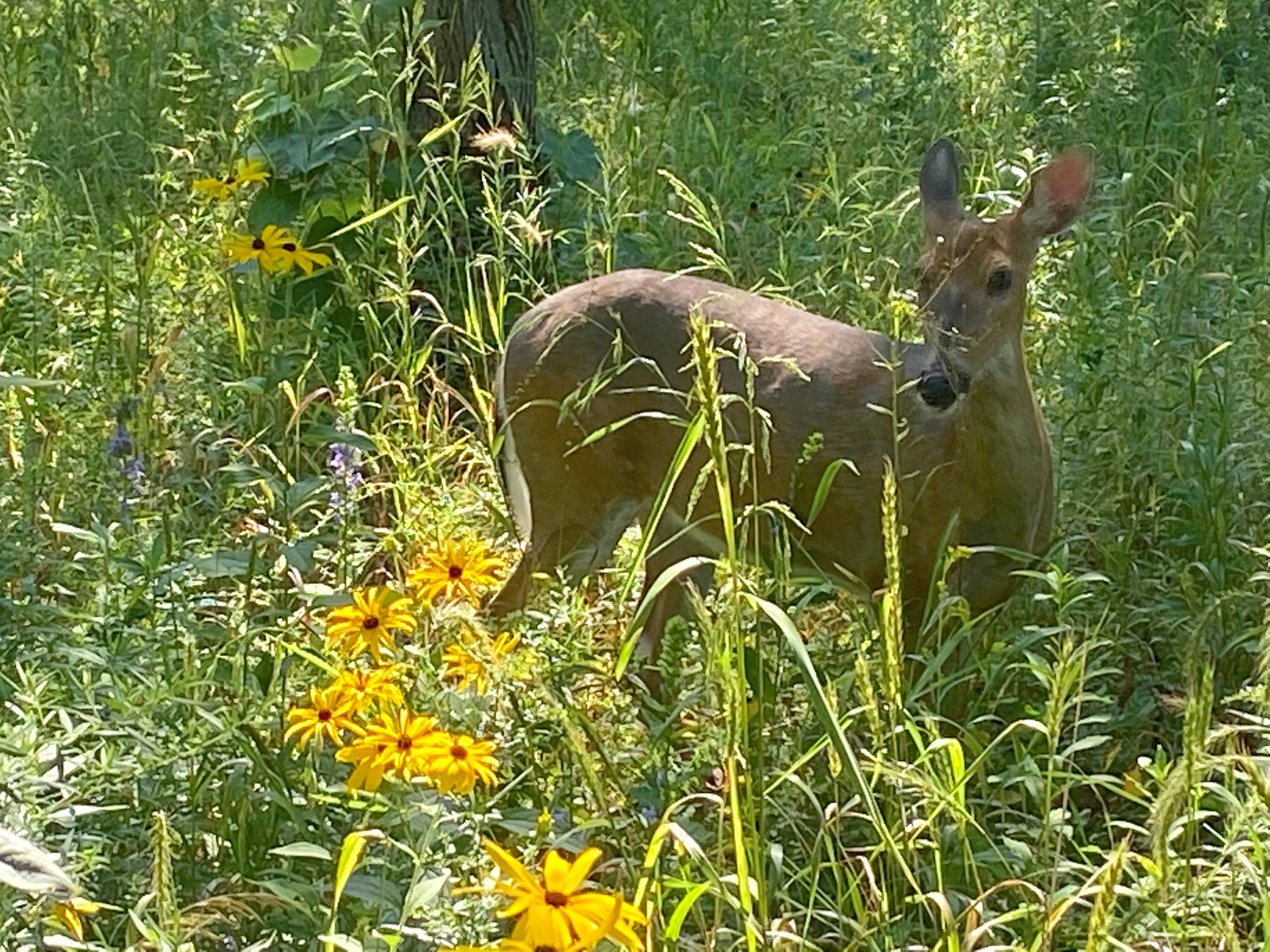

 She doesn't respond verbally, but she speaks with her presence. Indeed, she completes that circle around me. Staying close. Eating and joining in the refreshing shade on this warm day.
 By this last photo, the doe has traveled a circle and a half around me. It's been good. But I've finished my work in this spot and drift away, finding more thugs to scythe. At some point I notice that she's gone. It's an experience to wonder about. Wild nature is like this.


