Thursday, December 06, 2012

Wild and Crazy Foxglove


At first it seemed like a restoration attempt that failed. Then, for a while, this partly parasitic beauty just barely hung on. Gradually, we learned to nurture a species that had good reason to be called "wild and crazy."

The eared false foxglove (Tomanthera auriculata) is threatened in Illinois and under review by the U.S. Fish and Wildlife Service for the federal endangered list.

Eared false foxglove – first confirmed near the North Branch by a student of H.S.Pepoon, 
who probably traveled to its habitat on the “Crazy Train.” 
According to the “National Collection Plant Profile” of the Center for Plant Conservation, this species has “About 40-50 known occurrences, most with populations of only 25-250 individuals.” The largest populations are found in Arkansas, Mississippi, and Missouri. Recently discovered in Kentucky. Presumed extirpated in Michigan, New Jersey and Texas.

The species was already rare here in 1927 when H.S.Pepoon published the Flora of the Chicago Region. But one of the three occurrences he listed was a few miles south of Somme at “Dunning” – then a relatively wild and unsettled area. Most people didn’t want to live there, perhaps because it was the location of Chicago’s insane asylum. The main transportation to Dunning was called the “Crazy Train.” This false foxglove may actually be a bit unbalanced itself; the species seems not to do well in settled situations; the little rascal seems to need violent disturbance.

Methods

As we searched for seeds to restore health to depleted ecosystems, we noticed this foxglove in small numbers at three sites in Cook County; at each it seemed to be associated with areas where shrubs had recently been burned back by fire. Fluctuating shrub borders were once a major feature of the tallgrass landscape. Shade from shrubs can kill prairies. When we started with Tomanthera, most prairie managers were trying to wipe out shrubs completely.

We wondered if this species might have a role in the savanna dynamic (Packard 1988). We collected a few seed capsules from a few plants south of Dunning. We broadcast that seed in areas of Somme Prairie Grove that seemed similar to where we found it and had similar plant associates to those listed by Swink and Wilhelm (1994). A few years later we heard from Ron Panzer that a large population near Midlothian was about to be destroyed. Panzer provided us with about one quart of seed capsules, and we broadcast that seed where a few of the Dunning plants had bloomed  and similar areas.

Date of the First Seeding

Oh, yes, it would be great for this report if I could find recorded dates and details of those first plantings. I can’t, so far. I do remember that they happened.


Tomanthera’s seeds are odd and fragile looking, yet they survive in the soil 
and germinate after many years. What’s with the honeycomb effect?

A 1988 reference in Natural Areas Notes suggests that I may have sowed the seeds that early. I was collaborating then with Gary Horn, a fellow volunteer steward and an animal keeper at Brookfield Zoo. He carefully managed a “south of Dunning” site. We had just started to burn that newly discovered prairie, and the foxgloves popped up next to some burned shrubs. Gary has sharp eyes, and he discovered that deer were eating all the foxgloves before they could set seed. So he tried some recommended deterrents: he scattered human hair near the plants (a failure) and then lion hair (also failed). He finally succeeded with his ‘ultimate weapon’ – leopard dung. According to Gary, “Leopard dung has a smell beyond imagining.” He reported that his rare plants then flowered and set seed.

The first foxglove entry I can find in the Somme field journal comes ten years later:

“Sept. 4 (1998). Tomanthera auriculata appeared for the first time (although I can easily believe it’s been there previously; it would have been easy not to find it; especially since the flowers fall off by afternoon).”

For five years, no subsequent mention of Tomanthera in my journal – but in 2003 there’s the note:

“August 24. Found Tomanthera auriculata for the first time in years. Also first time in years that that area has burned. 31 plants along old footpath to Circle Grove … scattered up to 10’ from the trail. Also found one plant 2/3 of the way to the Pothole Pond ... Both of these (areas) have now been scythed.”

Here's the translation: An intense fire – scorching a brushy area that hadn’t usually burned – results in thirty-one foxglove plants. And why scything? A scythe is that long-bladed implement that Father Time carries on New Year’s. We had noticed that saw-tooth sunflower and tall goldenrod could become “thugs” – overpowering and eliminating most other vegetation, under some circumstances. In high-quality ecosystems, they’re not common but multiply after disturbances, like a scab that helps heal a wound. In degraded ecosystems, like we’re working to restore, they can get out of hand and prevent healing. In previous experiments, scything these thugs back into balance seemed to have long-term benefits for diversity generally – and especially for some rare plants. Now we started to help out Tomanthera by scything thugs in areas where it used to thrive. We later found that the foxglove sometimes returned years after scything. One good thing about crazy annuals is that seed may lie in the ground for years or decades, waiting for the right conditions.  

In July 2004 eighteen Tomantheras bloomed. So far so good. But a note in my journal that fall indicates that only one plant survived to make seed. That hurts. I remember a foreboding: What’s wrong here? Is Tomanthera doomed – a few plants pop up some years; then they’re gone, perhaps no new seed being made for the future. 

Almost certainly I took half the seed from the one successful plant and scattered it in other likely places. I find no note to that effect, but that's what I would have done with so rare a plant.

In 2005, the data page shows a whopping 75 plants bloomed. Did they survive to make seed? Did I check? No note on that. Certainly I had good intentions - but lots of competing work and only so much time. My comments in 2006 suggest disaster  and a determination to do better.

August 27, 2006: a jumble of rushed words:

“Put out 2 cages and 8 mouse traps for Central Swale population of Tomanthera. (There had been 6 plants on the 25th. One of them cut off at ground level on the 26th.) 28th: 1 short-tailed shrew. 29th: 1 each deer mouse and meadow vole.”

There my notes stop, but my memory is vivid. Mouse traps? Short-tailed shrew? The battle has just kicked up a notch.

Here's the drama, as it unfolded: On August 25th I had been excited to find six foxglove plants far from the area where I’d seen them in the past. (Probably I’d broadcast seed in all these areas back when Panzer donated it. Probably the little crazy little devils sense chemical and physical changes that indicate conditions may be right for them. Then they germinate and bloom. If they can set seed, the population may continue. If not, the population flickers out.) When I checked the next day, one of the six had been cut and sectioned. Not only were the deer eating the foxgloves from above; the meadow voles were attacking from below.

Voles are clever. They stay in grass tunnels but drag lofty seedheads down to them. A vole stands up and gnaws through the stem, grabs the new bottom, pulls it down to the ground, stands up, makes another cut, and keeps repeating that sequence until it has a pile of vole-length stems on the ground and the seed capsules down where it can eat them in safety. Hawks eat voles that are not hidden in the tunnels they make through the grass.

So on the 27th I probably pirated a couple of deer protection cages from some lesser priority species and put out 8 humane Havahart live traps baited with oats, peanut butter and molasses.

Next day, despite my efforts, another stem was vole-cut. Four left. If we could only protect just a few long enough for next year’s seed. I had a dozen snap traps to fight off the mice that otherwise devastated the rare seed we gathered and stored for later planting. But killing the little gerbil-ish rodents in the wild (even with FPD approval) felt different and more ugly. All the same, losing an endangered species population felt worse. However, no voles blundered into the snap traps despite delicious bait. One shrew was in one trap. Next day, another foxglove was gone.

On the 29th, one vole and one mouse died in traps. But others had avoided Havahart and snap traps to get another Tomanthera. The assortment of contraptions looked insane amidst the nature.

Next day, another foxglove down. Now just two left. I have other things to do in life. I don’t have time for this. But I go to the hardware store and get talked into a package of stinky stuff – blue cakes of foul stench – guaranteed to repel voles. I place four of them around those two vulnerable stems.

Next morning I return, wracked by angst. Yet the scene I see makes me laugh out loud. It’s an oddly free and happy laugh – a laugh of the absurd. I stare down at a little piece of wilderness decorated by 2 big green deer cages, 8 silver Havahart traps, 12 tan and gold snap traps, 4 bright blue stench cakes, and the last two foxglove stems sectioned and lying carnage among the pathetic technology. Every last ripening seed has gone to its doom.

I began to experiment with vole exclusion cages. They are harder to make and harder to install – a cylinder of half-inch metal mesh. I’m hoping they don’t need tops, because voles stay low. One more “to do” during a busy time of year – yet they work. 

Note from 2007: tried spraying repellent on the foxgloves.

2008:, all but three plants were destroyed by voles. Those three plants wore the newly invented vole cages.

An Angel from Darwin or God

Then a human miracle happened. A year earlier, mild-mannered occasional volunteer Lisa Culp asked if there was more she might do. I hardly knew her. She said later that I “baited” her with fringed gentians. Not really. But I did tell her that deer and voles had been eating nearly all of those rare beauties, and would she like to adopt them? Lisa, who sometimes compares herself to “the Energizer Bunny,” made deer and vole cages for every gentian, scores of them, a lot of work.

Lisa was celebrating a year of gentian success and happily preparing for the 2009 gentian season when I laid before her the plight of the foxgloves. She gave it some thought. Then the mass production of vole cages began. In 2009, all large plants were protected. Probably as a result, in 2010 Lisa had the great pleasure of being witness to a huge surge of foxgloves 178 plants – too many to cage – even for Lisa. Still, she caged scores of them.

Is this too much meddling with nature? I sympathize with whoever answers yes. To land managers and stewards who don’t want to do it, I say, “Great. Your site tests the No Heroic Action alternative.” Yet the effort seemed good to us. Can it be judged by the results?

2011 – now numbers have blown through the roof. 719 plants. Still caging as many as we can.

The graph below shows this population limping along in very low numbers for many years. Then it seems to explode. By 2012, we’re thinking that we may be “over the hump,” and perhaps so. But after you pause for a happy look at the graph, see concerns below.


In one big way, 2012 was a failure!  This year we rested on our laurels. We caged just a few. We concentrated our energies on other species. Voles ate most Tomantheras without a vole cage – many hundreds. We also lost about half the caged ones, probably to white-footed mice. (Voles stay on the ground, but the rascally white-foots are great climbers.) Maybe some foxgloves make so much seed that losing 95% of the plants is good enough? Many species on the planet lose most individuals – to something or other – and still prosper. Is it even possible that critters actually help distribute seed in some way?

Our decades-long study was gloriously imperfect. It had to outlast changes in jobs, places of residence, life goals, etc. This account suffers from some lost data. But it sure beats doing nothing – or those neat and complete little studies of a year or two. Let me revise that: it offers something that shorter and “more scientific” studies don’t.

Next steps for the foxglove at Somme? We’ll continue to ask advice from the best experts we can find. We’ll probably broadcast the much-increased amounts of seed in various areas and record as best we can what seems to be happening under various management regimes. At some point, probably, we may just tell Tomanthera to sink or swim without our help. It will find niches, or not, and persist, or not. Best of luck, Tomanthera auriculata.

Speaking of "next steps" - a 2024 update on this 2012 post is here

Credits

Principal credit for the success of Somme’s eared false foxglove in recent years goes to Lisa Culp who does most of the caging. She reports that she makes 16 vole cages per hour.
Great credit also goes to Forest Preserve District of Cook County fire manager John McCabe who has vastly improved the controlled burn program in recent years.

Thanks to Karen Glennemeier, Ron Panzer, Gary Horn, John Balaban, Bernie Buchholz, Linda Masters, Steve Flexman, Robbie Sliwinski, Doug Chien, Lisa Culp and many others for edits and for their contributions over the years.

Photos by Lisa Culp

References:

Center for Plant Conservation: www.centerforplantconservation.org/Collection/CPC_ViewProfile.asp?CPCNum=6601
(Note that scientific names change, and Tomanthera is also called Agalinis.)

Cunningham, Maureen and Patricia D Parr, Successful Culture of the Rare Annual Hemiparasite Tomanthera aurucularta (Michx.) Raf. Scrophulariaceae), Castanea 55(4) 266-271. DECEMBER 1990

Packard, Stephen, 1988, Rediscovering the Tallgrass Savanna of Illinois:
digicoll.library.wisc.edu/cgi-bin/EcoNatRes/EcoNatRes-idx?type=div&did=EcoNatRes.NAPC10.PackardSavanna&isize=M

Swink and Wilhelm, Plants of the Chicago Region, 1994.

END NOTES

1. If anyone who lives nearby would like to help on this (or some other) rare species, let us know through “Comments” here or “Contact us” at www.sommepreserve.org. There are lots of great experiments to try for anyone who finds this work compelling.

2. Some people think we should not reveal the locations of rare plants. They may be right. There’s danger of misbehavior if rare species locations are not kept within a limited community. Botanical psychopaths may steal plants or seeds from known populations. They may degrade, damage or destroy other populations or ecosystems as they indulge in “copycat” vigilante efforts of their own design. But secrecy can also kill. We need to build constituency and enthusiasm for endangered species work; we need our ideas enriched by broad discussion. Overall the best results may come from empowering more conservation than can possibly be done by the grant-driven scientists and plodding bureaucracies that, bless their hearts, do most now. This argument suggests the need for “wiki” type safeguards, ethics, and communication. Your thoughts? 

Saturday, November 17, 2012

Burn at Somme Prairie Grove - Quick Report


November 14, 2912

Top priorities were three high quality wetlands. 
For months the overall weather has been dry, dry, dry. 
This was our first opportunity to burn our best wetlands in three decades.

Here is the Swale Pond? Can a pond go up in smoke? More on that later. But first, note the difference between backfire and headfire. With 20-foot flames, the headfire is running with the wind, partly obscured by smoke. Can you see the backfire? It’s creeping towards us, mostly one-foot flames barely visible above the dried sedges.

But those twenty-foot flames are heading toward an oak grove. Should we worry about what will happen when that wall of fire hits the trees?


No need to worry. Oak woods fires are different from wetland fires. Here the head fire (on the right) isn’t much bigger than the backfire. This woods burn is a cool one, because we had a bit of snow a day earlier. The oak leaves, lying flat, are still damp. In contrast, dead grasses are surrounded by moving air and have dried out quickly. Especially today, the low fire in the bur oak woods won’t hurt the oak trunks.


Where oaks stand in the grassland, it’s a different story. Scarlet oaks, like the ones in the background, keep their leaves all winter and have thin bark on their trunks.


This scarlet oak looks like the Bible’s burning bush. Even such a mild back-burn through thin fuel torched this one. But don’t feel bad for it. A scarlet oak loves to burn. It’s a “fire tree” that wouldn’t be able to compete here at all without combustion clearing the competition from time to time. It will re-sprout vigorously and grow bigger each year, until some future fire clears the competition and gives it a new start, once again.


The big tree here is a cottonwood. This species survives the burn by growing in ponds. Though dry now, the pond that this cottonwood stands in had too little fuel to start the tree on fire.


A dead, dry tree lying in the grass is another story. This year, the old hulk of a huge downed cottonwood finally met its maker.


In the foreground, believe it or not, we’re looking at another seasonal wetland, the Pothole Pond, which is knee-deep in spring when we usually burn. In the spot where I stand to take this photo, teal and wood ducks swim among chorus frogs and blue-spotted salamanders in April and May. The fuel that’s burning here is a plant called “floating manna grass.” In spring it floats. Now it burns.


The Swale Pond is an older, more mature, more vegetated wetland and has denser fuel.  Here the head-fire is just starting. [swale fire early]


Though deeper than the Pothole Pond, the denser fuel makes a much hotter fire.


The entire pond burned in just a couple of minutes. This is probably the first time since the reign of the Potawatomi that this wetland and its rare, fire-dependent plants have burned.


The black towers here are made by tussock sedge. A great diversity of wetland plants thrive here - some of them very rare and fire dependent. We can’t wait to watch the ecology respond to this too-long-overdue burn in the years ahead.


Here in the uplands, the tussocky bumps are made by dropseed grass. Notice the burned stems of shrubs. If this area burns frequently, the shrubs will be suppressed, and an open grassland will thrive.


But what happened here? On the edge of the Swale Pond, the fire just went out when where the grasses thinned at the edge of our biggest shrubland, the Bird Thicket. Without the fuel of either grasses or oak leaves, this thicket would burn only under extreme conditions. Patches of unburned ground are part of the “pryo-diversity” that makes for ecological diversity.


To a steward, getting the burn successfully done is a great relief and a great pleasure. Though fire is dramatic and beautiful in itself, the main beauty will be the unfolding of the flowers, shrubs, trees, birds, butterflies and all the biodiversity of rare nature that will thrive here yet more bountifully in 2013, thanks to this invigorating fire. 

Credits 

Many thanks to the people who made this fire effective and safe: 
especially John McCabe who manages the fire program 
of the Forest Preserve District of Cook County 
and Patrick McCrae who led a hard-working crew 
from Pizzo and Associates (an ecological restoration company 
that did this work under contract with the FPD).

Thursday, November 01, 2012

Where Have All the Dollars Gone?


Where have all the gentians gone?
Long time passing …
Where have all the buntings gone?
Long time ago …
Where have all the bureaucrats gone?
Writing each other emails, every one.
When will they ever learn?
When will we e...v...e...r learn !?!

We had not expected an eco-shocker to come out of the budget hearings. Oh yes, there were little shocks, like the budget for ecosystem restoration was reduced by 6%. That’s not a good thing certainly, given that un-cared-for forest preserves are deteriorating. And most are still uncared for.

So, yes, as good mild-mannered advocates and constituents, we expected to stand before the Commissioners and say, “Thank you, Sir. Oh, praise you for the pittance, Ma’am. And could you possibly give a tiny bit more?”

Indeed, in recent years many things had gotten better. And the promises have been great! Hopes were brighter.

Indeed, there was a grass-roots reason for that. Finally, in 2002 we stopped groveling long enough to do an on-the-ground “audit” of what was happening to nature. Then we held a little press conference. There were front-page headlines, actually, and the County Board President (who cared little about forest preserves existed but was, by law, also the president of the Forest Preserve District) sat up and took notice. He may not have known forests, but he knew bad headlines. He fired the head of the District, and clearly told the incoming replacement, "Solve this bad PR problem! Listen to these people!"

Thus began an increasing “Restoration Landscape Budget” – small compared to the need – but way bigger than the nothing that had preceded it. We praised it at budget hearings.

Of course there was the little problem that, despite repeated requests, we couldn’t get any “actuals” on how the funds got spent. And many important projects seemed not to get much help. “Sorry, we’ve run out of funds this year,” was the all too common refrain. Yet it was comforting to know that increasing millions had been appropriated annually to restore good health to our prairies, wetlands and forests. 

No doubt, it was being spent, effectively, to get the job done. Don’t you think?

Why does money make a difference to nature? Under current conditions, if you start with a high quality ecosystem and leave it alone, it degrades (loses plant species, for example) at about 3% per year. The graph below, the one we released to the press in 2002, shows the result:

That huge mass of orange rightly horrified the Commissioners. 68% poor. These lands are worth billions, and people love them, for nature.

Actually, even more important numbers were in the green and earth tones – the 32% that was pretty good or easily recoverable. That part was degrading fastest. Much of it needed little beyond an occasional burn. But recovery gets more difficult, more expensive and more iffy as the patient declines.

Forty expert volunteer botanists had done the sampling that produced this summary:


So if this was how the ecosystem looked in 2002. How do you suppose it looks in 2012? “About time to re-do the audit,” many people said. Might have been good to do it earlier, but some feared that wouldn’t have been fair test. Ecosystem healing is slow. Yet now, ten years on, after staff increases and $23 million plus in restoration, surely we should see quality on the rise. 

Then came the latest shocker - in response to two kinds of complaints. First, people who love the preserves took unkindly to reports that the FPD was planning to divert land to conference centers, zip lines and other non-forest-preserve uses. Since that rankled, conservationists protested perhaps more than they otherwise would the 6% decrease in restoration funds and pressed harder for release of the long-requested “actuals.” Yikes. See below: 

The officials seemed to expect that people would be comforted to know that the increase wasn’t needed, because it “couldn’t be spent” anyway. Just look: less than half the promised funds get spent each year.

Hello? What?

Emails began flying: “How can it be that we’ve sat through so many meetings and been told that the money was gone this year?” Or: “I’d been told so many times, by people I trusted, the priority I advocated had simply lost out. The money for that year’d been spent.” Or: “How can we distinguish lying from don’t-care or incompetent?”

Some people talked in terms of personal betrayal. But the individuals involved mostly didn’t know the details. This is an institution that keeps some cards close to the vest and the rest in its pockets.

The fundamental, unanswerable charge is that the system didn’t work. A crucial $12 million worth of time-sensitive, critically important treatment was withheld from the stressed wildlife and nature that needed it.

What’s next? A serious overhaul is needed. Couldn’t the budget of this little conservation agency be transparent? Will procedures (or people) be put in place to get the healing work done from now on? Will staff have to measure and be responsible for results? Will conservationists and the public be given reports on where and how the funds were spent?

Doesn’t seem too much to ask. 

Cook County Forest Preserve natural areas - 55,000 acres of orchids, salamanders, tanagers, oaks and flying squirrels - need the answer.

Sunday, October 21, 2012

Buckthorn Kills


Or is that ugly green mess really more of a symptom?


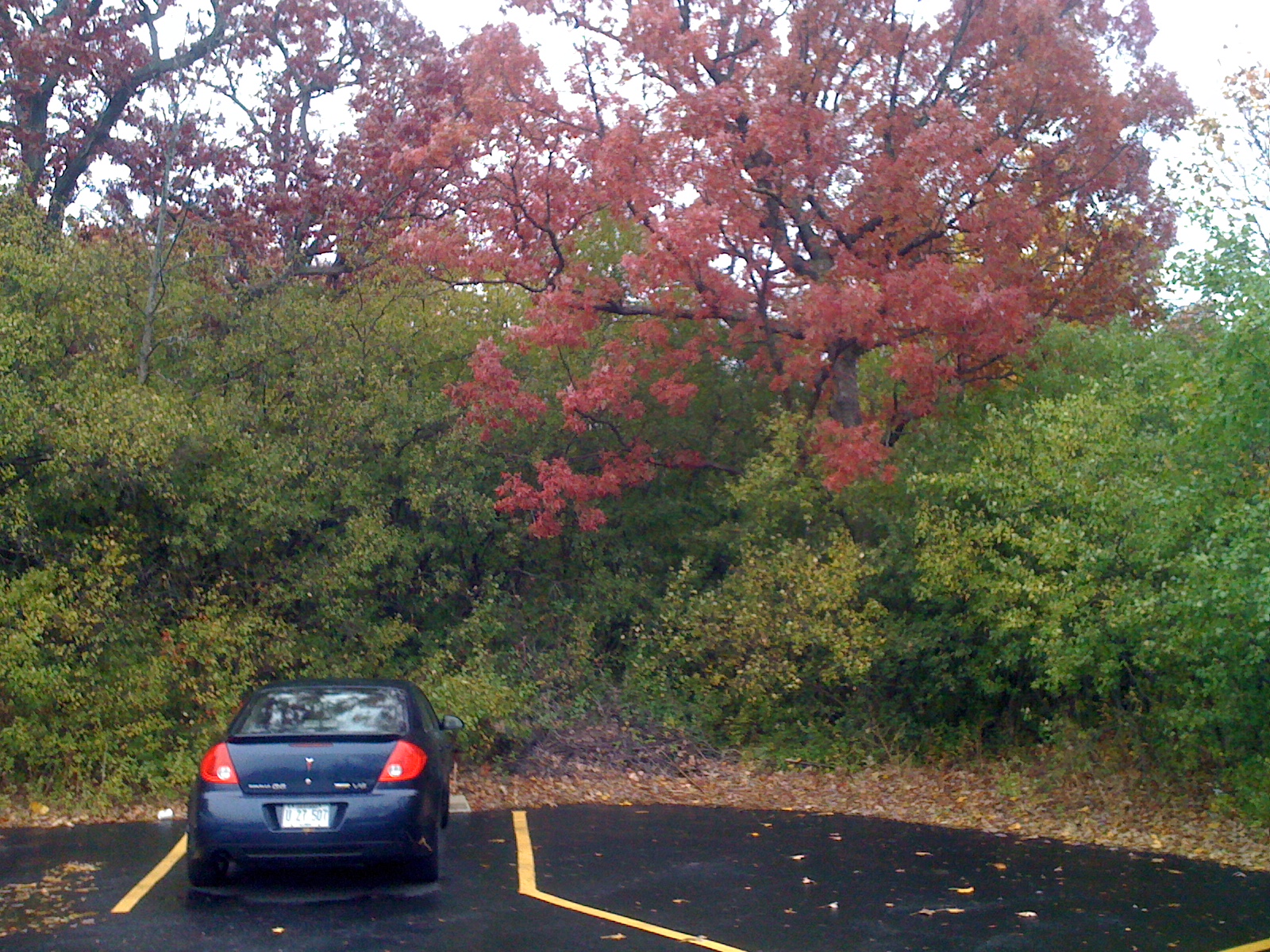
Hundreds of species of animals and plants have been lost from this
formerly open white oak woodland, under suffocating invasive shade.
But neither buckthorn nor asphalt is the major threat to our remaining
biodiversity.  
October is a good time to teach people that the smothering green of buckthorn is an evil. But what about the claim that it's really more of a symptom more than a cause? More on that later. The fact is that buckthorn is easy for people to understand, so teaching about it is step one.

In the fall when it stays green later than everything else, everyone can see it. Buckthorn brush densely lines highways, parking lots, and any neglected corner. It invades people's yards. Once people know it, they swear at it, at least subconsciously, every time they see it. 

The wine-colored white oaks (right, above) cry out for help: "Get this stuff off of my ecosystem!" Long gone are the butterflies, birds, wildflowers, woodland sedges and grasses - and hundreds of other species that once lived here. While there has been no oak reproduction here for decades, at least the old trees survive to beg us to be stewards.  


In the scene to the right,
the buckthorn was cut from the foreground last spring. Hundreds of baby buckthorns then sprouted and were herbicided. The oak ecosystem will be 'restarted' by sowing the seed of wildflowers and wild grasses this fall. The two spreading trees in this photo are bur oaks. This species needs plentiful sunlight to survive as saplings. The smaller skinny trees in the foreground are red oaks. They tolerate some shade. No young bur oaks have grown here for decades.


The evil of buckthorn is obvious
on the right side of this photo, where it hasn't yet been cut. But another "evil" is less obvious on the left. Those yellow leaves are maple - as shady a character as buckthorn. Now we get a bit closer to the root of the problem. If the killer of these oak woods wasn't buckthorn, it would be maple or some other invasive tree. In the absence of burns, shade tolerant trees in the oak woods are like cancer cells, growing out of control, enough to kill the ecosystem.   


In parts of Somme Woods, all the oaks have already died. Here the young trees are basswood and ash. But check out the big trees with spreading branches in the distance. Survivor oaks are still nearby. Squirrels have been "planting" their acorns decade after decade. Soon, once thinning has provided enough light, "the oaks will rise again."


Elsewhere in this preserve,
outside the woods,
along the edges of the open grassland, hundreds of young bur oaks do indeed rise up. Notice prairie grass and dense wildflowers around this one. This great little tree grew in full sun. It's happy.


Back in the woodland we have the remains of a white oak. Oh, golly, my heart goes out to it. Look at those shade-killed lower branches, though the top (outside this photo) is still verdant and beautiful. Where are the other big old oaks with spreading branches? Only one is visible here - dead - lying on the ground - rotting into history. The anorexic young trees that stand behind it grew un-oak-like in the absence of fire. Nor are there many white oaks among them; dark bark means the skinny trees are mostly red oaks. Dense young reds are not as bad as maple, but they too mean the end of the white oaks woods -  and the end of the dappled-sun-dependent animals and plants that pal around with the big gray monsters. More fire would help this woods.

Lack of fire is the root problem. Buckthorn, maple and red oak are the symptoms. There is a "light hierarchy" among trees. Bur oak grows next to the prairie and needs the most fire and the most light. Then comes white oak - in open woodlands. Last is red, mixed with the maples where oaks are on the way out. Bur can't grow in the shade of white, which can't grow in the shade of red, which can't grow in the shade of maples and basswoods. Plants and animals need us to restore remnants of all types. White oak woods like this deserve to be opened up enough for the old white oaks to reproduce.


This is what grows under the buckthorn - seedling buckthorn and little else. Without fire, this is dead end for a formerly rich and beautiful woodland. If the understory were young maple, the result would be just as fatal, but not nearly so obvious to the casual observer.


Compare the monoculture above with the richness on the left. Where restoration has provided its benefits for decades, the ground layer supports a more than 100 rare plant species. Shown here: long-awned wood grass, Short's aster, and woodland puccoon (with all those white seeds). 

Conservative diversity means health to the ecosystem. With this richness, the birds and butterflies thrive. Oak seedlings rise slowly but surely. beating out the weak, small-seeded, fire-intolerant invader trees.


That's why we cut brush
every winter
and gather seeds every fall
to help the oak woods of Somme
heal their wounds
and burgeon
once again with diversity of life.


We rejoice at the recovery.
This is the home of the woodcock, blue-spotted salamander, Bicknell's geranium, and hundreds of other species of now-rare plants and animals.
And we are none too soon. Look at the state of these oaks! We can almost hear them gasp:

"Oh, thank you for making space for our seedlings. You rescued us just in time!" Really? Ancient trees are that thankful? It's so nice of them to appreciate our work. 


Saturday, September 29, 2012

WHAT A STEWARD THINKS ABOUT: September 2012


The photos below show what I looked at and thought about as I mapped where this year's various seed mixes should be broadcast.  

SPECIES IN TRANSITION
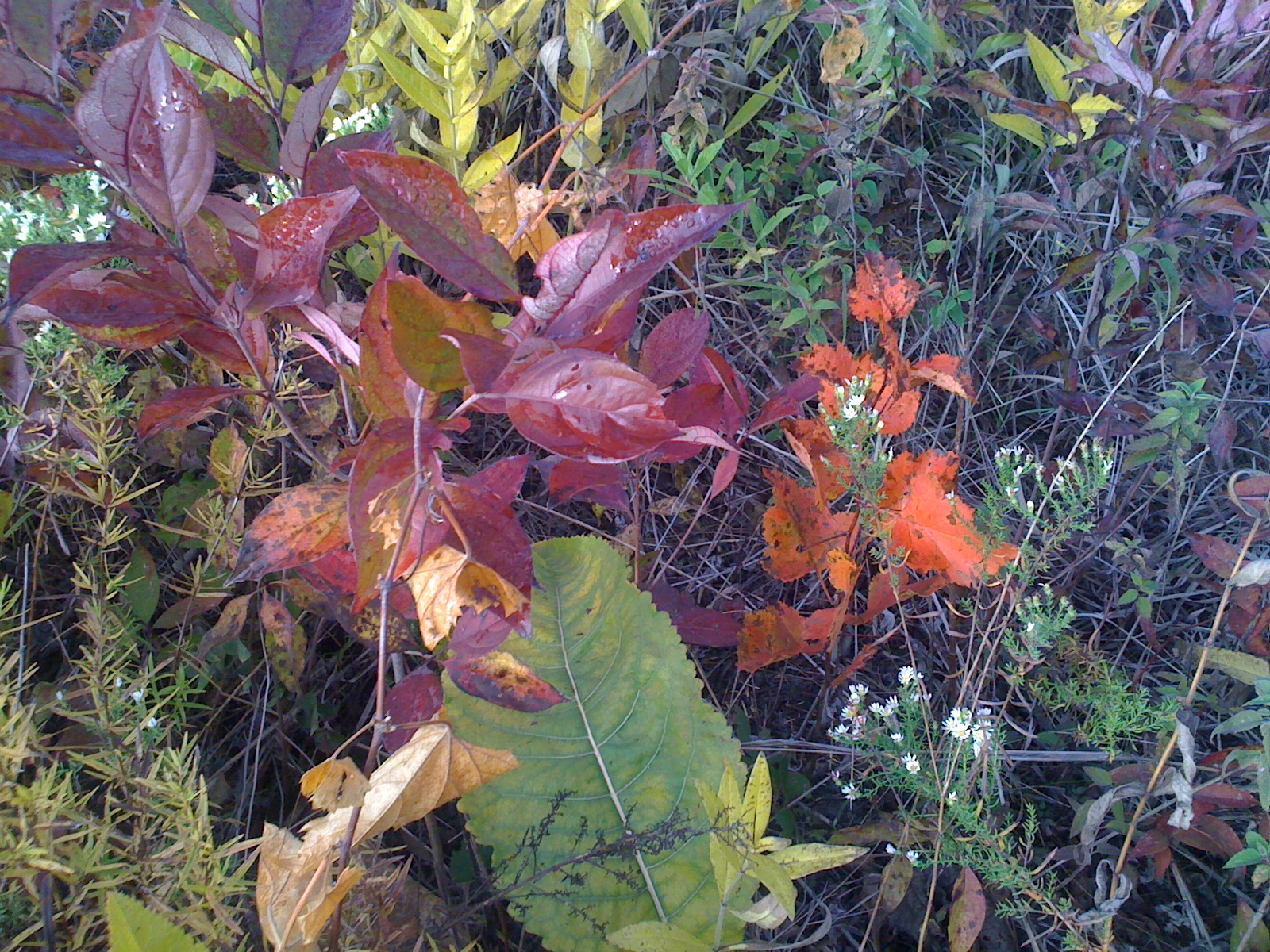
The subdued rainbow leaves are wild quinine. The sapling in the middle (gray bark, small yellow leaflets) is a shagbark hickory. I wonder how long that hickory will be here. It represents a possibly-natural disturbance. Its trunk burns off and re-sprouts after every fire. This little trunk is two years old. It will probably burn off again this fall.

The tall plant with the bright green leaves is tall goldenrod. It’s a weed, not a bad plant, but one that, being common, indicates that top quality species haven’t yet reached an advanced stage of succession here. More conservative associates of wild quinine will replace this weed, if we seed them in.  

MANY YEARS INTO THE RESTORATION PROCESS
These dropseed grass clumps are probably twenty years old. We also planted forty or sixty wildflower species in this same mix, most of which are now present in small numbers. The other main color today (dark red-purplish) belongs to gray dogwood, a shrub. In prairie restoration, many people try to eradicate it. But in this savanna, it’s natural as dirt. If we stopped burning for ten years, dogwood would probably be six to ten feet tall and start shading out the species that need full sun. If we burned every year, the dogwood itself would probably be choked out in time. Savanna is always flowing in the tides of change.


THE COLOR OF EVIL.
In this case, deep green marks the evil one. The shrub on the left is common buckthorn. Green late in the season, it works overtime to shade out every other species in this photo. 

Buckthorn we don’t mess with; we herbicide it. People used to think it would burn out in time. Frequent fire can keep it low like this, but it persists and degrades (and forces us to burn more often than perhaps is good for some animal species, given how small our preserves are). 

There are at least a dozen species visible here that buckthorn would shade out and kill. Most obvious are compass plant (deeply cut leaves) and cream false indigo (vaguely bluish gray). We won't sow more seed here until the buckthorn is gone.

BABY DROPSEED
It’s so cute. The bright green grass here will fill this frame when it matures, but that process will take some years. The seed this youngster grew from probably flew from our broadcasting hands about four years ago. As it grows, the wild quinine (gray seed heads to the left and multi-colored leaves) will still be here, but smaller and fewer.

Other species in this photo: little bluestem (curly reddish leaves), golden Alexanders, prairie rose and early goldenrod will also still be here. The latter was a dominant. It’s often dominant early in the process of restoring an old pasture, like this was. But it is very generous about mostly giving way to more conservative species in time. As this dropseed grows and the community re-adjusts, this will be a good time to seed in some of the rarer spring species like prairie betony, violet wood sorrel, shooting star and prairie violet.


OKAY, OKAY
I admit that the prairie dock leaves here steal the show. But what I see most are the columns of gray seed on the leadplant in the background. They scold me with reminders that we need to finish the harvest – so that the conservative plants of this rich patch can be broadcast in the many, larger patches that are still begging for restoration.
(Plants in bloom here: heath aster and azure aster.)


REMEMBERING COWS
The bright orange here is hawthorn. Dogwood and hawthorn are now the commonest native shrubs at Somme. Hazelnut and wild plum were probably more common in original tallgrass nature. Heavy grazing helped the hawthorns. It will be fun to watch how the various shrubs increase, decrease and move around the site under the influence of restored frequent fire.


TEMPORARY BEAUTY
Stiff gentian is now the commonest gentian on the site, by the thousands. We never found much seed of this rare plant, but from the little we did it reproduced “like crazy.” The crazy part probably has something to do with the still transitional nature of the restoring ecosystem here. In time, stiff gentian will probably retreat from areas of the most conservative full-sun species – and will thrive where the shrubs keep things stirred with all their growing-up and shading-out and burning-back and starting-over.


CLEVER OAK
Some oaks escape the fire by hiding in shrub patches. At least fifty nearby bur and scarlet oaks are equally old, but three feet tall. Their tops burn off, and they have to start growing new trunks every time the savanna burns. Brush patches suppress the grassy fuel. So the fire usually skips the oaks in shrub patches. By the time this shrub patch does burn, this oak may have developed enough thick corky bark to protect it. Then we’d have a mature old oak in the making.


PROBABLY NOT A WINNER
This ash tree got its top burned off (see all that black at the bottom). It’s putting up re-sprouts (and holding up a grape vine). Oaks, hazels and plums are masters at re-sprouting. Ash is not. Over the years, with burning, we expect ash to fade out (along with maple, like that orange tree in the background). As they decrease, classic savanna trees and shrubs will increase.


UNINTENTIONAL SELF PORTRAIT – with big bluestem and dropseed.

I don’t know why my phone/camera did this weird thing on my walk back to "civilization." Maybe there's a message. 

If you’re still here, thanks for taking this walk with me. 

Stephen Packard

Saturday, September 22, 2012

MADE FOR EACH OTHER: bird and flower


Like the glass slipper that fit the princess, this flower fits this bird.

a female ruby-throated hummingbird works a cardinal flower. Their co-evolution goes back millions of years.

Insect eyes don’t see red. Red means hummingbirds. Most flowers are blue or yellow or white and pollinated by insects. Bugs have done that job for more than 200 million years. Nectar-feeding hummingbirds have been in action for 30 million. (It took a while for dinosaurs to get this small.)

Until this year, no hummingbirds nested in Somme Woods for decades. Invasive brush had wrecked the habitat. Now that we're restoring health to that ecosystem, the hummingbirds finally returned to give us their seal of approval in 2012.

Cardinal flower pollen seems to travel from flower to flower on the tops of hummingbird heads. I can’t find any published reference to this arrangement, but if you doubt, look below. Each separate flower is topped by a long tubular structure that ends in grayish white reproductive organs. To appreciate the sequence of five photographs below, watch that structure in relation to the bird's head.


Indeed - like the glass slipper that fit the princess, this flower fits this bird.

Adaptation. References say that it’s “costly” for a plant to develop a pollinating relationship with hummingbirds. Cardinal flower (Lobelia cardinalis) is the only one of the 19 lobelia species in the eastern U.S. that has done it (others are blue). In exchange for moving pollen to ovaries, the bird requires a great deal of nectar and a specialized form of sugar, and the ruby-throat is pretty rough on the plant, compared to butterflies or bees. Cardinal flowers thrive in isolated wetlands; hummingbirds fly long distances to find red flowers. Perhaps that's part of why they need each other. 

Somme had five red wildflower species, spanning the seasons, and they’re all popular with ruby-throats: scarlet painted cup and columbine (spring), fire pink and Michigan lily (summer) and cardinal flower (fall). But now - the drum roll of drama: All five of these red beauties were rare, often eaten down to just leaves by over-abundant deer, until the last few years. (Deer populations have been reduced by culling and possibly disease).

Scarlet painted cup never came back. (We keep hoping to find a nearby seed source to restore it.) The other four species are now plentiful.

In addition to nectar, ruby-throats also eat large numbers of tiny insects and no doubt enrich the complexity, health and balance of the woodland ecosystem.

Long live the ruby-throats and their red flower friends.

There is an updated version of this post - with some additional photos.

--------------------------------------------------------------------------------------------------------
References:
http://en.wikipedia.org/wiki/Ornithophily
http://www.illinoiswildflowers.info/wetland/plants/cardinal.htm

These photos were taken in Somme Woods by restoration volunteer Lisa Culp, who had a splendid time at it. She sat very still in a quiet woodland glade. The female in these photos got quite tame. (It's the male that has the ruby throat; he didn't get tame.) Part of the thrill was finding these woods rich with red flowers and summer hummingbirds again. Restoring diversity and health makes us happy.


"Lobelia flowers are bisexual; that is they produce both pollen and ovules in the same flower. To ensure that self-fertilization does not occur the stamens (pollen-producing structures) mature earlier than the pistil (ovule-producing structures), therefore the pollen grains are released before the stigma on which the pollen grains will land becomes receptive."
http://www.ntbg.org/plants/plant_details.php?plantid=7159