Saturday, July 26, 2014

A Walk in the Opulence of July

Nine photos of restored savanna and woodland 
at Somme Prairie Grove
July 2014
followed by thoughts on what they mean to conservation.

Elderberry (white flowers, above) is a shrub that meets the needs of birds, wine-makers, jelly-cookers, photographers ... it's a great shrub. Most of our shrubs and small trees burn off with every prescribed burn. One of our challenges at Somme is managing, despite frequent fire, to keep the thriving patches of shrubs that birds need for nesting and foraging. 


Shade in mid-day. Ninety degrees. Like people, many animals need to move in and out of shade to regulate our (and their) temperatures. Flowers in bloom here: starry campion, woodland sunflower, and purple Joe-pye-weed. 

Near woods and thickets, the diverse, short-statured "prairie" vegetation gives way to the exuberant tangles that mushroom up when a woody edge is cut or burned back. The sprawling monster plant that takes up most of the top half of this photo is showy tick trefoil. Would you like a plant ID challenge? Can you find, in this photo (in rough order of prominence): purple prairie clover, prairie dock, lead plant, rattlesnake master, black-eyed susan, gayfeather, Culver's root, yellow coneflower, fleabane, early goldenrod, Kalm's brome, obedient plant, gray dogwood, cordgrass, prairie dropseed, big bluestem, saw-toothed sunflower, and river grape? Find 'em all? Notice any others that I missed? 

Carolina rose and prairie sundrops both have seeds that are difficult to separate for efficient planting. But just get a few going, and they'll spread splendidly by themselves.


Amid purple prairie clover and leadplant, the fine leaves of grass that arc horizontally are prairie dropseed. It's the dominant grass of our finest black-soil prairies. 


Even rarer than the purple is white prairie clover. Note how much wider its leaves are. It can grow in somewhat wetter and shadier habitats.

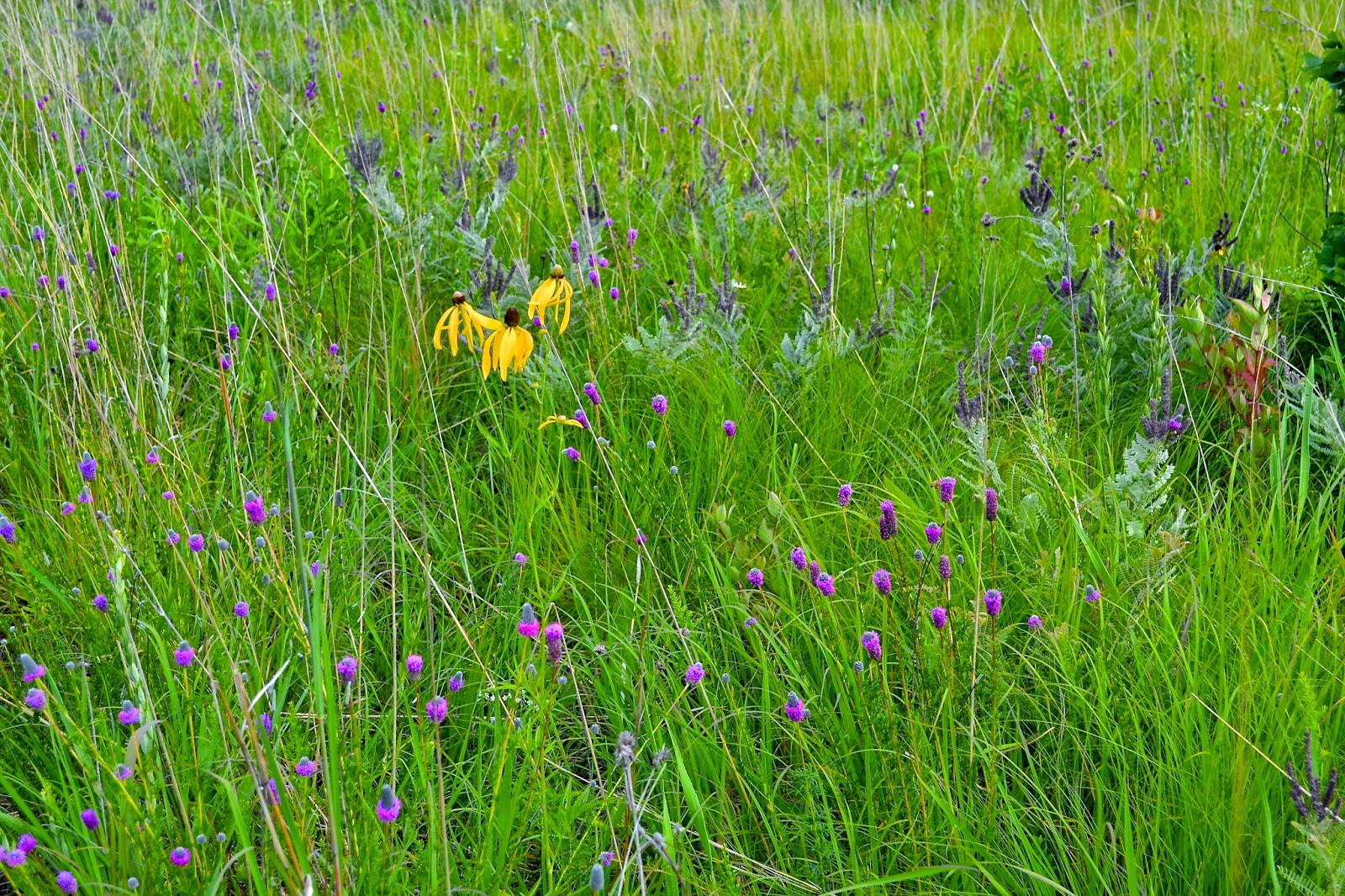
The lonely yellow bloom here is a "prairie" or "yellow" coneflower. Twenty years ago such coneflowers waved in all our open areas by the thousands. But they don't compete well with such conservatives (above) as dropseed, lead plant, silphiums, and white and purple prairie clover. Look for them in young restorations - or around animal burrows.

Still mostly buds here, the coming of the cardinal flower makes us already wistful. The richness of early summer is soon behind us. The richness of late summer approaches. Cardinal flower will attract daredevil hummingbirds through August and September. Soon to bloom: the tall grasses, blazing stars, asters, sunflowers. Golly. 


Your “Comments” and discussion are always appreciated by this blog.

There’s a different treatment of these same photos here - where they’re described from a more technical, restoration perspective. Check out that blog too - and see which you find more interesting?


Wednesday, March 26, 2014

A History of Collaboration

March 24, 2014

To Restore and Restock
Biodiversity Restoration in the Forest Preserves of Cook County

This account summarizes the pioneering work done by professionals and volunteers as they developed new (and now widely respected) approaches to conserving our natural woodlands, prairies, and wetlands.

A goal for the Forest Preserves of Cook County from their inception, was “to restore, restock, protect and preserve the natural forests and such lands together with their flora and fauna, as nearly as may be, in their natural state and condition.”

Learning to do this well would take decades. But it is worth noting that even the earliest reports and plans of the District featured a map of the original vegetation of the county (mostly prairie but with woodlands along the rivers) and celebrated the woodlands, prairies, and wetlands for their natural beauty and recreational value. The early reports also featured collaboration with citizen volunteers and conservation groups, as it was obvious from the beginning that more ambitious goals could be achieved this way.

Starting in the early decades, Forest Preserve resource managers have done restoration, as it was then understood. They planted woodland and grassland (maintained initially by mowing) for both wildlife and people. Staff members were among the first to experiment with habitat restoration. At the inception of ecological restoration as a scientific discipline in the 1940s, conservation superintendent Roberts Mann and others were in touch with Aldo Leopold and others at the University of Wisconsin as restoration concepts developed.

Researcher Natalie Bump Vena found:
Following the Illinois Natural History Survey's recommendation, in 1940, Roberts Mann contacted a University of Wisconsin ecologist who was leading a prairie restoration with CCC labor in Madison. The ecologist, Theodore Sperry, traveled to Cook County in August 1940 to help the Forest Preserve District plan its own prairie restoration using work relief labor. Sperry drafted a plan for the work, but with the onset of WWII and the end of the work relief programs, the District had to abandon the restoration. Between Roberts Mann and Doc Thompson (who had worked at the Illinois Natural History Survey), an interest in prairies lingered in the Department of Conservation. During the 1950s, important Chicago-area naturalists, namely Floyd Swink and Doc Beecher, worked in that Department.

“Beginning in 1962, naturalists in the Forest Preserve District began developing expertise in prairie restoration by experimenting with land management techniques on property attached to the nature centers. In the mid-1960s there even existed a nursery for prairie plants in southern Cook County. People often attribute the first use of agricultural techniques in large-scale prairie restoration to Bob Betz in the 1970s. In fact, Westcott and naturalists at Crabtree Nature Center began using farm equipment to establish prairies there in the 1960s. At Camp Sagawau, Dave Blenz carried out a meticulous restoration that resembled Ray Schulenberg's Morton Arboretum project in technique.”[1]

For a time, the tree and grass species that were planted reflected what was available and practical, without limitation to local or even North American native species. But expectations changed as the prairie restoration experiments at the University of Wisconsin began to show that true ecosystem restoration was practical. David Blenz’ highly respected prairie restoration at Camp Sagawa was one of the first in the Chicago region.

Another strong influence on ecosystem management was the Illinois Nature Preserves Commission. Recognizing the importance of new insights into nature preservation, Forest Preserve Superintendent “Cap” Sauers was a founding member of the Commission and helped develop its principles and goals. When the Forest Preserve District enrolled key parcels of its land (as eleven of the first twelve Illinois Nature Preserves), it gave prestige and momentum to this important new institution.

Both Blenz and the Commission emphasized the importance of fire to the natural prairies. When in the 1970s, additional prairie restorations were planted at River Trail, Crab Tree, and Sand Ridge Nature Centers – controlled burns were conducted regularly by staff as a critical part of management. For the Nature Preserve prairies, such as Shoe Factory Road Prairie, Forest Preserve staff sometimes authorized the Nature Preserves Commission to take responsibility for the burns.

As was true for many agencies, prairie restoration fostered a rethinking of the basic principles of forest preserve management. Until the 1940s the consensus was to “leave nature to manage itself.” Gradually, ecologists and resource managers everywhere were learning that fire could be a valuable tool and than cancer-like invasive species could degrade healthy ecosystems and eliminate the diverse “natural flora and fauna.”

The heritage of Blenz and the ongoing work of Westcott, Strand, and others focused the Forest Preserve ecosystem restoration on the Nature Center plantings and the high quality prairies and savannas at Shoe-Factory Road, Sand Ridge, and Thornton-Lansing Road Nature Preserves.

In 1977, volunteers offered to help out on half a dozen little prairie remnants along the North Branch of the Chicago River. Superintendent of Conservation Roland Eisenbeis thought long and hard about approving their offer, but he was a dedicated conservationist, and the losses were increasingly apparent in many Forest Preserve grasslands, so in August of 1977 he approved a trial. The volunteers were given the okay to cut small brush with hand tools and gather and plant seed in the areas cleared. He also asked Westcott to be their mentor.  

It was an auspicious time for such a beginning. Television and newpapers often featured Dr. Betz’ prairie conservation efforts, and environmentalism was flowering everywhere. A spirit of optimism reigned as the national gloom of Viet Nam and racial conflict receded. Volunteers from the surrounding communities adopted the new mission, and the brushy or formerly mowed prairies increasingly burgeoned with life.

After an auspicious start to the North Branch experiment, “disaster” struck in August of 1978(?). Staff from the North Branch maintenance division mowed its prairies at the height of bloom. Although little long-term harm was done, it seemed like at least the maintenance staff were not “with the program.” A flood of phone calls and letters criticized this apparent reversal. Those objecting included neighbors, conservationists including Dr. William Beecher of the Chicago Academy of Sciences and, perhaps equally influentially, the Ward Committeeman from the Sauganash area. Support for the volunteer initiative that Eisenbeis had approved was impressive. The maintenance staff (not always on the same page with the conservation staff) was chastened.

At this point, Eisenbeis decided that the program needed more depth. He invited the highly respected Dr. Betz to tour the sites with forest preserve staff heads: Sam Gabriel (chief forester), Joe Nevius (landscape architect), John Mark (Superintendent of the North Branch Maintenance Division), and Eisenbeis himself. Representing the new North Branch Prairie Project (NBPP) were volunteers Larry Hodak and Steve Packard.

Betz endorsed the project and suggested expanding from just small brush and seeds to full prairie restoration. The meeting established ongoing relationships among all those present, which served the effort well for many years. One result was increased mentoring by Chuck Westcott, who began to supervise burns at the prairies. The entire leadership of the NBPP met from time to time with Eisenbeis and other staff to improve management plans and discuss progress. A key person who joined this process was Richard Buck, long time Chief Landscape Architect for the preserves. Though Eisenbeis was the ecologist and conservationist, Buck seemed to have more influence with staff outside the nature centers. He also shared ideas on prairie and forest restoration that dated back to his work with legendary preserves superintendent Cap Sauers.

Restoration expanded substantially in 1978 when the Illinois Nature Preserves Commission began to donate resources in support. It hired a Steve Packard to recruit volunteers for the most important preserves in the six counties of northeastern Illinois. The Nature Preserves Commission had already been doing some of the management in the District’s eleven nature preserves, and now Packard was able to provide more support to that effort. At that time, Illinois had a crop of young biologists and conservationists who were “state of the art” in ecosystem restoration. Packard joined in the training they all were getting and soon was writing management plans, supervising burns, and partnering with agency landowners in all six counties. Soon Cook County was benefitting from the advances of this new field as staff from the state and many counties worked on plans and developed techniques collaboratively. Key people in Cook County at this time were Marlin Bowles, Jerry Paulson, and Packard from the state along with Eisenbeis, Buck, Westcott, Strand, and eventually Ralph Thornton in the newly created position of Land Manager.

In 1983, Packard left the Commission and joined The Nature Conservancy (TNC), which recognized the opportunity to add resources to and expand this good program. TNC staffers who worked on the expanding number of Cook County restoration efforts in included Jill Riddell, Gill Moreland, Paul Dye, and Laurel Ross. The Conservancy trained its staff intensively, flying them to extended “field seminars” in Nebraska, California, Florida, and wherever the most respected scientists and land managers could teach the best planning and management. As with many agencies from coast to coast, the District’s contributed to and benefited from principles and practices being developed by the Conservancy.

Recognizing the need for more staff leadership, in 1995(?) the District added two key people to Thornton’s Land Management staff. Kelly Treese became Volunteer Coordinator and Steve Thomas became Restoration Ecologist. Although each site had its own individual management plan (initially in the form used by the Nature Preserves Commission but then moving toward the more simplified and practical forms developed by the Conservancy), Thornton and Thomas saw the need for county-wide plans and standards. Thomas developed the District’s first standardized community descriptions (for its various types of woodlands, grasslands and wetlands), with management protocols for each. Rather than re-inventing the wheel at each site, why not list the major problems and treatments appropriate to each community? Management plans could then cite the general protocols and focus on the detail of whatever is special about each site. As the Field Museum’s president Sandy Boyd later said about the work on Chicago Wilderness, “Nothing is ever born full grown.” But gradually the discipline of ecological restoration was maturing.    

Throughout the eighties and nineties, the restoration program grew, with staff support from both the Conservancy and the District. Familiar landscapes were being gradually changed in sometimes dramatic ways, and though public response had been overwhelmingly favorable, it seemed important to add more outreach. Well-known writer, birder, and conservationist Jerry Sullivan (formerly with TNC) joined the District staff and began producing materials to support the growing biodiversity conservation initiatives. Dave Eubanks (formerly with Openlands Project) joined the staff as “Greenways Planner.”

In the mid nineties, highly publicized protests were directed at the forest preserve conservation programs of DuPage, Lake, and Cook Counties. The conflict had initially focused on the deer control programs of these three counties, where the restoration efforts were most advanced. It expanded to include criticism of tree and brush control, fire, and herbicides. This “political headache” and “teachable moment” is described elsewhere, but part of the fallout included divisions within the staff. Disappointed and frustrated by perceived lack of support – Westcott, Thornton, Treese, Thomas, and Eubanks took early retirement or resigned. With the untimely death of Sullivan, the entire program needed to be rebuilt.

A new Volunteer Coordinator, William Koenig, made some progress at re-establishing the staff support for the volunteer program, but it was too much for one person. Yet he deserves great credit for restoring morale and maintaining the collaborative nature of the program. He also engaged Resource Management staffer, John McCabe, who gradually became the principal trainer (and defender from staff members who had been at odds with the program).

Partner organizations also increasingly chipped in. The Chicago Region Biodiversity Council (nick-named “Chicago Wilderness”) brought together the region’s best conservation scientists, land managers, planners and educators – dramatically improving the expertise available to staff and volunteers alike. Key Chicago Wilderness member organizations included the Field Museum, Openlands Project, U.S. Fish and Wildlife Service, U.S. Forest Service, National Park Service, Northeastern Illinois Planning Commission, Chicago Botanic Garden, Morton Arboretum, Chicago Academy of Sciences, Illinois Department of Natural Resources, Illinois Nature Preserves Commission, Nature Conservancy, Audubon, many universities, and all six of the region’s forest preserve and conservation districts. Some critics continued to complain that the science behind the conservation and restoration program was insufficient. But now they were clearly criticizing one of the most impressive assemblages of ecosystem management expertise on the planet, so the charges lost their credibility for most. 

Leadership from Nature Conservancy diminished (with changes in national priorities) as it discontinued its volunteer staff in the region. Packard and Ross went to the Audubon Society and Field Museum, expanding the partnership through these locally larger institutions. Nature Conservancy conservation scientists continued to advise.

A new organization, Friends of the Forest Preserves, also began to help. In one of its first initiatives, it joined with the Audubon Society and Sierra Club to organize an impressive “Land Audit” in which forty expert botanists with forty trained assistants took data on trees, shrubs, wildflowers, and grasses under protocols scientifically designed to assess the ecological health of the 55,000 most “natural” acres of the preserves. The study was supervised by Wayne Lampa, recently retired DuPage Forest Preserve ecologist, who had supervised a similar study there.

The results, widely reported by area newspapers, showed that the small areas under restoration were doing well, but that 68% of these preserves’ natural land were in poor condition. A parallel study of FPD management overall (conducted by Friends of the Forest Preserves and Friends of the Parks and coordinated by Steven Christy, former head of planning for the Lake County Forest Preserves) reflected the need for changes long recommended by FPD staff. These studies had a major impact on the FPD Board, and president John Stroger appointed an excellent Acting General Superintendent, Albert Pritchett, who began needed reforms. Stroger then hired a new General Superintendent (City of Chicago forestry chief Steve Bylina) who made major improvements. A Resource Management Department was created and many new resource managers hired.

The election of FPD Board President Toni Preckwinkle brought in many reform principles and Arnold Randall as General Superintendent. Substantial funds were appropriated for contract restoration work (gradually increasing to $5M in 2013) and the volunteer program got three new staffers (Kathy Wurster, Mike Saxton, and Jonathan Schlessenger) to strengthen and expand that program.   

The District (now calling itself the Forest Preserves of Cook County) is poised to embark on new leadership initiatives with its “Next Century Conservation Plan.”

This history continues past this 2014 post, of course. Parts are reflected in many subsequent posts. 


[1] Natalie Bump Vena, Ph.D./J.D. candidate, Northwestern University, personal communication, December 12, 2013.

Saturday, January 25, 2014

Historic Commitment (if we follow through)

Forest Preserves President Tony Preckwinkle Proposes Major Initiatives


January 24th, 2014 may go down in history - beside the launching of the Burnham Plan and the founding of the Forest Preserve District - as a day that changed the future. 

Under the plan announced by Preckwinkle, the Cook County Forest Preserves would spend $40 million dollars a year to restore 30,000 acres of woodlands, prairies and wetlands to Natural Areas Inventory quality. The plan envisions 400 expert volunteer stewards playing a key role alongside staff and partner organizations. 
The "Next Century Conservation Plan" is filled with photos of people
using and appreciating the woods and prairies. This plan is for the generations.
The photo below from Somme Prairie Grove is the main cover graphic. (Somme deeply appreciates the honor.) The photo seems to say, "Biodiversity is a treasure to cherish." Underneath the nature photo are five photos of diverse people enjoying compatible recreation. Yes, public involvement, appreciation, support are key. The full plan in on line at nextcenturyconservationplan.org  
Restoring this quality at Somme took three decades. The plan proposes
restoring 30,000 acres to "Natural Areas Inventory quality" in 25 years. 
The Technical Report of the plan cites the 2007 study 
designed by scientists from the Illinois Natural History Survey, the FPD, and Audubon -
which was carried out largely by expert Habitat Project volunteers: 

"According to this most recent land audit, only 25% of high-opriority conservation areas (approximately 3,500 of 14,000 high-priority acres, or about 5% of the Forest Preserve' total holdings) were found to be in good or excellent condition. Given the ongoing deterioration of the Preserves' biodiversity, the restoration and maintenance of the natural areas is a matter of the utmost urgency."   
A bur oak woodland - its understory and reproduction gradually being choked out by buckthorn
The plan (which in February will go to the FPD board for approval, with President Preckwinkle's support) calls for the training and empowerment of 400 expert volunteer stewards. Recognizing that such a goal will take many years, the plan also credits the existing stewards with much of the best restoration work done to date.

The plan also proposes jobs. In addition to beefing up the Forest Preserve professional staff, the plan proposes a "permanent" force of "at least 500 conservation corps members - built on partnerships that provide supportive workforce training for at-risk youth and young adults." 

This oak woodland was as choked with brush as the one shown previously. After thirty years of restoration
it has attained good quality - but still has a way to go to achieve high quality. Staff and stewards are rapidly learning the more effective and efficient approaches that make the plan's 10- and 25-year goals achievable.
Students from Evanston Township High School exult in victory over brush, as a bonfire burns behind them.
From the plan:
"Decades of neglect have allowed our diverse woodlands and grasslands 
to lose their wildflowers and become impenetrable thorn thickets. 
Eroding soil silts our streams, ponds and wetlands. 
With the loss of natural systems comes the loss of public benefits. 
Without a healthy restored landscape, our metropolitan region
 will be dirtier, hotter, less safe and less attractive."

Processing rare seeds for woodland restoration. It will take tens of thousands of people many decades to accomplish the plan's goals. Those diverse people, if you believe this photo, include one with an orange jacket and no head. 
The vision statement of the Next Century Conservation Plan:

VISION

The people of Cook County will celebrate and nurture 
our thriving woodlands, prairies, and waters as world-class treasures 
that sustain our great metropolis. 


There's a lot to consider in the actual plan. Check out nextcenturyconservationplan.org 
Stewards may find the "Technical report" (under the first tab, "The Plan") 
to be especially worth some thought.

Comments on this blog can also help the discussion.
Much education, listening, and support will be needed if this plan is to achieve its wise goals.

Saturday, January 18, 2014

Plant Quests and Questions - for sixteen species from prairie to woodland


Adventures with ecosystem recovery, 
considered with nostalgia, reverence, and hope - 
in the cold of winter.


Vestal Grove was home to little or no trout lily when we started. But we've thrown seed around, 
and once a plant's established it spreads underground dramatically. 

Hairy and elegant, stargrass is one that's hard to restore by seed, 
in part because the seed is so hard to get,
and in part because most seeds we've planted don't produce a successful plant.
But we've been raising hundreds in a garden, where thousands of self-sown seeds have produced hundreds of plants. We harvest a little seed, 
but mostly we dig up and plant garden-raised bulbs 
into widely scattered prairie, savanna, and woods areas. 
Bit by bit, dropping their own seed year after year, they spread slowly from there.
Where we once had none, we now see scores of recruits as much as five or ten feet from those original bulbs. 

The first little purple leaves of prairie betony are often the first spring color we see. Betony is now widespread, because the seeds are easy to gather, and they do very well.
As the central buds unfold, large areas will be bright yellow.
They seem to promote diversity of conservative plants.
Those fringy green leaves to the left are rattlesnake master. 

Shooting star doesn't rush. 
From seed, it takes a plant about ten years to grow big enough to bloom in the competition of the wild. When we started at Somme Prairie Grove we had only a few single plants. We've gathered seed from each, and we let some blow around the parent plants. Now we have thousands - new plants widely scattered - and big patches where the original ones were. 


Of cream false indigo, we had none at Somme Prairie Grove. We scattered seed from rare remnants where it survived. Now there are hundreds. These days they spread their own seed by rolling like tumble weeds when dry in fall. 
(We also pick and scatter a lot, gathered early. Otherwise the weevils eat most of it.)

A few plants of veiny wild pea showed up in our early surveys. 
Then we saw not a one for decades. Deer eat it. 
Then in 2012, one plant showed itself where we'd been scything tall goldenrod. 
We put a cage on it, and in 2013 it was many stems needing many cages. It was along an old fence line. Inspired and looking carefully, we found three more plants hundreds of yards away, but all along old fence lines. These were remnant plants. Now they all have cages and have become patches with scores of stems spread more than twenty feet from those original survivors.
Better solutions are needed to reduce over-populated deer.    

We have so many close-ups of the prairie white-fringed orchid.
Lisa decided to try to capture its relationship to the ecosystem. 
Other plants, most visible here, if you look close, include Dudley's rush, beard-tongue, saw-tooth sunflower, spiderwort, Virginia mountain mint, compass-plant and gray dogwood. 
If we don't have effective fires, that gray dogwood can shade out and kill all those other plants. 

Characteristic of only the highest quality prairies, our prairie lilies are widely scattered. A few survived at Somme Prairie but none in the savannas of Somme Prairie Grove. 

At Somme Prairie, we found six in 1998 but only two in 2007.
We started caging them from the deer and sending some the resulting seed to the Chicago Botanic Garden - which started new bulbs for us - which we then planted in the preserves. 
In 2019, steward Eriko Kojima carefully monitored and found 43 plants blooming in Somme Prairie and 53 plants blooming in Somme Prairie Grove.

Dr. Betz always told us that the short, little Leiberg's panic grass typifies the finest prairies.
This species has spread massively for us from the limited seed we've gathered. Its chocolate stamens and feathery pistils make gorgeous flowers, if you study them close up.

Thickets of native shrubs and vines at most sites are now mostly replaced by buckthorn.
Wild plum flowers are beautiful in early spring. 
The summer fruits also have eye beauty - in addition to mouth beauty. 
Here in a tangle with grapes they remind us of how crucial mammals are to the savanna. 
Mammal disperse big seeds. Big fruits and nuts are designed for mammals. 

Of cardinal flower, we had very few, and most years the deer ate them. We salvaged a few seeds 
and gave them to Bill Valentine who propagated them in his yard. 
Bill returned massive amounts of seed and now these beauties are plentiful in many areas. 

A celebrity for us in 2013 was rough white lettuce. 
We'd never seen it bloom at Somme Prairie Grove. But it wasn't a surprise, since we finally found nearby native seed and grew the corms for transplant. In this case, the seeds blow widely 
with the wind in their parachutes. It will be a treat to see where the new colonies appear.
Spoiler alert, once again, we haven't seen this species for years. 

Savanna blazing star is recognized by a) long stalks on the flower heads 
and b) flat, green leafy bracts. After much conservation work, 
this species may be ready to come off the Illinois threatened list.
Hint to plant fans: there's an animal in this photo. Look carefully. 

When we started, we thought no black-soil fringed gentians survived within our 15-mile seed-gathering limit. So we made a deal with Dr. Betz, and Larry Hodak harvested 6 capsules 
from Markham Prairie. We paid back the seed with interest 
when nearly 200 plants thrived at Miami Prairie that very first year. 
Being annuals, they're vulnerable to difficult weather and over-abundant deer. 
Some years we've seen none. Some years we see thousands.

When I see a photo like this, I wish I were a pollinator. I want nectar. I want pollen.
Are the fringes just decoration? No, they're there to ward off pilfering ants.
Only welcome here are flying insects that spread the genes from plant to plant.

Blooming prairie gentians mean fall - and then winter. 
Its color is so achingly deep. 
Except when warm sun inspires pollinators to fly, this gentian twists to close up tight. 
Bottle gentian never opens at all. Only bumblebees are strong enough to get inside and pollinate.
Gentians protect themselves from crawling bugs, perhaps just too numerous by late fall.
Thus, over evolutionary time, three gentian species came up with three solutions.

Photos by Lisa Culp Musgrave in 2013. Thanks, Lisa, for another year's worth of visual treasure 
to love and ponder. 
Some species accounts updated later.


Tuesday, January 14, 2014

WINTER REVIEW - 2013 in photos - animal edition

The 27 photos below, by Somme's "Photographer Laureate" and co-steward Lisa Musgrave, 
are highlights of another special year. Winter is a good time to study and think and plan. 
As you yourself think, consider having your own year of nature in favorite places, 
perhaps doing something special, next year.  

In winter, Somme's blue-spotted salamanders are tunneled deep in the soil, 
hibernating, waiting. As soon as spring melts the ice on our ponds, these slimy 
little sweethearts will be heading to the ponds to breed.

 The blackburnian warbler, in our winter, it is catching tree-top insects in Peru;
during the second week of May it will be at Somme;
all summer it will be bringing up babies in Canada.  


Congregations of spring peepers make so much noise as they sing for mates 
in Somme Woods ponds that they drown out the sounds of highways and airplanes. 
In the summer they'll climb around trees, looking for insects to eat, not so different 
from the blackburnian warbler. Note the suction-cup-like toe pads. 


Eastern bluebird hunts from a bur oak branch sprouting its first leaves of spring.
When these forest preserves were mostly dense buckthorn, no bluebirds nested here. Now multiple pairs nest annually in Somme Prairie, Somme Prairie Grove, and Somme Woods. 

That furry blob with incredible legs is a flower fly, 
busy pollinating one of spring's first wildflowers, toothwort. 

Could you recognize a rare Lincoln's sparrow? With a little practice, you could. 
Its upper breast is a warm buffy color. The streaks through the buff are thin and dark. 
Here it sits in a hawthorn. You could identify that too, by its very long, thin thorns. 

It surprises some people that vultures nest in Somme Woods. They hide the nests inside hollow fallen logs. Their big babies have no black and no red - just a clean elegant gray. Very handsome.

Scarlet tanagers have also returned to nest in Somme Woods for the first time in many years. 
They like the open oak woodlands that are the restoration goal of steward Linda Masters 
and all the steward volunteers. 

Another elegant and handsome creature, the eastern wood pewee.  Our stewardship work has much expanded its habitat. We now hear it singing from one end of the woods to the other. 

What's this plant doing in the animal edition? Something about that bug on the top open flower?
No, it's here to celebrate a potential. A rare butterfly, the silvery blue, is nearly gone from Illinois. Its caterpillars need this plant, the veiny pea. And after not being found for decades, this pea appeared in four places in Somme Prairie Grove this year. It gives us hope that the silvery blue may return too.

Not the silvery blue, but a similar little cutie, the summer azure.

Another plant to introduce a another co-adapted animal.
Insects don't see red. Plants evolved with pollination by hummingbirds are red. Somme now has most of its original red flowers. Scarlet painted cup was finally re-introduced by seed in 2013. We'll keep our eyes open for it, possibly blooming in 2015. If so, the humming birds will pounce.

In fact it was only in 2013 - for the first time since we've been stewards - that there were enough humming birds for Lisa to be able to photograph two at a time. Not on sugar-water plastic feeders. But in thriving nature. Here their red beauty is cardinal flower.

The ruby throat of our hummer looks black in most lights.
But if you catch it just right, it's one of the most brilliant colors in nature.

Females and young have plain throats.
This juvenile male is just starting to get his first red feathers.
I wonder if his voice is changing too. 

One of Somme's many species of bumble bees drinking deeply of the nectar of great blue lobelia. 

But what kind of bee is this? The great conservation mentor Dr. Robert F. Betz always hoped that people would emerge to study specialties. We have people at Somme monitoring rare plants, birds, butterflies, frogs, and dragonflies. Who'll study the bees?
 
Betz also hoped people would study the flies. This one mimics a bee. 
There are so many amazing-looking species. Few study them. Discoveries are waiting.


 This photo shows paper wasps in the little shed where we keep our tools. My head passed within inches each time we retrieved or stored rakes, loppers, saws, whatever. Most species of bees and wasps won't bother you if you respect them. Which is a good idea.
   

 The orchard oriole is another rare bird that's returned to Somme's restored areas. 
Here both male and female look at Lisa with bugs in their mouths. That means 
they have babies near by. The parents seem friendly, but they're really worried 
that you're a predator of baby orioles (just as they're predators of bugs). The first-year male (above left) has not developed the rich brick-red he'll sport next year as a fully mature male. 

Speaking of babies, Lisa found these curious young raccoons. 
Their mom would scold them if she found them being foolish like this. 

Tiger swallowtail on gayfeather.
Its caterpillars eat tree leaves; birds eat most caterpillars; but a few will become this.

 Damselfly.

Picture-wing fly. This is the one that creates the "bullet galls" on goldenrod stems. 


This chipmunk is eating its food and letting scraps fall on the oak branch. She doesn't clean up. 
Isn't it great that there's no "mess" anyway ?

In its spare time, this chipmunk is caching food for winter. 
Soon he or she'll be semi-hibernating - once in a while eating some stored nut.

We stewards spend the winter cutting brush, taking vacations, planning for next spring, 
and reaching out to possible new friends and colleagues. 
Captions of this blog are by Stephen Packard. Your comments are invited.