Monday, July 29, 2013

Planning Notes for 2014


Updated Feb. 15, 2018 - but including the public comments (at the end) made in response to the original post.

This post is intended for people who are interested in the details of ecological restoration. It consists of five “cases” – with photos that exhibit problems or opportunities and comments on possible solutions.
The initial "Diagnoses" and "Prescriptions" were written in 2014. In 2018, we commented on what we'd actually done and learned since then.

First, a definition of a word used often below:
conservative – a species that is most common under long-evolved natural conditions – and rarely is found away from them. In fine prairie remnants, the conservatives are among the most common plants. In most “restored” or degraded prairies, they are rare or non-existent. A more detailed note on conservatives is at the end of this post.


Case 1

Diagnosis: Weeds here are under control. Yet few conservative species are established. Most of what’s here are short termers – species likely to mostly give way to others, for better or ill, before long. The early goldenrod, for example will likely be replaced excessively by big bluestem (present now in small numbers) if nothing is done but burn.

2014 Prescription: Broadcast seed of conservative species. Especially important are little bluestem and prairie dropseed – to head off the big bluestem. One place to sow seed of conservative species is the denser early goldenrod areas. These areas are ready.

2018 Comment: We do some of this, but not enough. We haven't sufficiently remembered this good advice at seed-gathering and seed-mixing time. We need to map opportunity areas more carefully this summer, plant some and hold back some as controls, and monitor the results. We are putting the needed mapping and seeds goals on our 2018 summer and fall priorities calendars.

SOMEHOW THE PHOTOS WERE LOST FROM THIS VERSION OF THIS POST.
GO TO THE 2018 VERSION AT:
https://vestalgrove.blogspot.com/2018/02/planning-notes-revisited-2014-to-2018.html

Case 1A: close-up of a different part of area 1

Patches like the one shown above strike me as receptive to our most-prized conservative seed. There is currently little aggressive tall grass here. The commonest plants shown (early goldenrod, black-eyed Susan, fleabane) are among the quickest to move out of the way for quality species. Sow such classy species as cream false indigo, Leiberg’s panic grass, white and purple prairie clovers, prairie dropseed, alumroot, shooting star, prairie gentian, yellow stargrass, prairie cinquefoil, etc.

However, if you look closely at the photo above, you'll see quite a bit of gray dogwood and grape. Shrubs and vines may be holding this area back, especially if it doesn't get burned frequently. Woody plant shade may be progressively killing off most seedlings in most areas until the next burn - at which time the whole process starts over with more fleabane etc. Perhaps we may want to laboriously cut and herbicide those prairie-killing shrubs. Or perhaps you we to schedule this plot for annual burns until a more competitive herb flora wins out. 

2018 Comment: We've watched this area and are more impressed than ever that "burn-off-and-regrow" shrub dynamics are ruling this area. Is that a good or bad? Certainly shrub dynamics are a component of the savanna dynamic. But are we missing half the species here that once made up that dynamic? Some say the principal shrubs were hazel and oak. Perhaps the grasses and forks that grew with them in this context aren't here now. And if so, is this now just a "retarded" weedy area that's stuck? We should install a transect of permanent plots and monitor plants here over time, to see if this area is changing, and how. Then we'll be better equipped to decide whether some change in protocols might improve it.

Case 1B: close-up area 2

This patch shows quite a bit of young big bluestem, dense patches of mountain mint, young ash trees, and dogwood shrubs. A patch like this may be less prime for conservative seed. Given how little seed we have of the high conservatives, we might want to seed this area sparingly. Perhaps it’s a place to add somewhat aggressive species like rattlesnake master, prairie dock, and compass plant – to increase the diversity of niches that the high conservatives will use to gradually become established from better areas nearby over the decades.

2018 Comment: Yeah, fine, 2014 commentator. But we really don't know the answer unless we monitor with permanent plots. Tom Vanderpoel assures us that prairie clover and shooting star will help break down dense big bluestem areas over time. Yes, we've seen that too. We've also seen areas where the bluestem resists other species for, it seems, decades. We would benefit from more permanent monitoring plots in seeded areas of dense big bluestem, mountain mint, tall goldenrod, and other resistant areas, to see what species might do best there. 

Case 2

Here two high conservatives dominate (purple prairie clover and prairie dropseed).  Early goldenrod (which was dominant here years ago) has retreated to the frequency you might expect in stable, high-quality grassland. Although we see a little rattlesnake master, compass plant, and rough blazing star – the
overall diversity seems low. It might not work so well to sow the high conservatives of mid-summer here; the competition could be tough to overcome. Perhaps this is a place to sow spring species such as prairie betony, shooting star, and cream false indigo, which might then open up more niches.

On the other hand, this area is currently a great seed source for dropseed and prairie clover, so perhaps there’s no need to do much here in the short term. The best next step could be a variety of little inter-seeding experiments. First, find out which species will compete against these conservatives – before investing a lot of seed in an area, which might be slow to accept it.

2018 Comment: Ahh, yes. More experiments. Good ideas. So many plants and plots, and so little time.

Case 3
Two big questions here:
First, what do we do with the new planting shown below? It has good wildflower diversity but is weak on grass (and thus, unstable). As we study the vegetation that's emerging from the first seedings here, it’s hard to know whether this plot wants to be more mesic or wet-mesic overall. we’re thinking that we should especially sow dropseed and little bluestem in the drier parts – and switch grass and Dudley’s rush in the wetter parts. (At Somme, Dudley's rush seems especially common in many of the highest quality wet-mesic areas and is an especially "works-well-with-others" plant, that many conservative and endangered species thrive in when their seeds are broadcast.)
But, second, perhaps the biggest question here is what to do with all those trash trees in the background. This whole area was so dense with buckthorn that essentially no grasses or wildflowers survived. But in the foreground area, a grassy turf survived with only scattered invading trees, and when we cleared them, an on-the-way-to-quality seems to have come back. But under the large numbers of ash, cherry, elm, and box elder trees in the background, the quality is still poor. Strategically, it would take too big a big chunk of our volunteer time to cut and burn them. But there’s now no sensible community to try to restore on the former prairie or savanna land underneath them. So our short-term strategy has been to plant natural species that may keep out the invasives and then wait until we have more time or a better answer. If you look closely, you may be able to see brown leaves on some of the trees to the right. That’s where fire singed some of the branches. Maybe fire will do most of our work for us here, over time, while we invest our resources on other areas where the prescriptions are clearer.
2018 Comment: since 2014 we've cut a few big basswoods and box elders out of that wooded area and spread a bit more "Intermediate" light-level seed. Mostly we've ignored the area except for being happy that the burns have carried through at least some of it. Our impression is that vegetation diversity and conservatism is improving. But we have no monitoring transects here. It continues not to seem like a big priority, for now.

Case 4
            The above patch of scarlet oak savanna seemed to be getting increasing diversity and quality – until recently.
            Around the tree on the right, notice wild quinine, butterfly weed, ox-eye sunflower, big bluestem, wild bergamot, rattlesnake master, and others.
            Then woodland sunflower (Helianthus strumosus or perhaps hirsutus) started wiping out much of that diversity. Perhaps this is a temporary stage, and diversity will come back? Or perhaps this sunflower is helpfully erasing species that aren’t so well adapted here, which will then be replaced by better-adapted species, if we broadcast their seed.
        
2018 Comment: In many areas, depauperate patches of woodland sunflower are spreading. It seems worth our time to monitor these areas to get to understand them better – and experiment by inter-seeding likely associates, if we can identify good candidates. (Check out lists of associates. The old Swink and Wilhelm was little help, but the new "The Flora of the Chicago Region" by Wilhelm and Rericha seems to have a lot more to study.)
           
Case 5
Diagnosis: About half the trees in the center isolated grove shown above are dead. Some died from fire and others from Dutch elm or Emerald ash borer diseases. The few oaks are fine. Because we hadn’t had time to focus on it, we’ve left this dying grove to “nature.”  Of course, “nature” isn’t happening here, and the result is an increasingly unsustainable weedy and brushy mess. It will soon be another buckthorn monstrosity if we let current processes continue.
Possible Prescriptions:
            We might plant some of our precious mixes of rare grasses and wildflowers around the edge. One mix is designed for the "Intermediate" semi-shade of the edge. A "Woods" mix might compete well in the darker shade of the interior). That could help keep the buckthorn at bay, but it could also be a waste of seed and effort. Throwing rare seed into nasty buckthorn re-sprouts is a recipe for failure. Also, the Intermediate species that would grow there in the short term would not be adapted to the less shady conditions that are coming – as these mostly non-oak trees continue to die from disease and fire. Why waste rare seed that would have more payback elsewhere?
            Perhaps we could broadcast the seed of some of the easier-to-get semi-shade herb species in the shadier, inner, non-buckthorn areas. We'd hope that those species would seal the wound and ward off the brush? Perhaps. Or we could plant natural shrub-copse species in hopes to build another native shrub island that we could experiment with (much appreciated by the significant bird species that nest at Somme).
            Or we could short-circuit the misery and cut the out-of-place trees this winter. That would seem easiest. We could then just plant the open savanna/prairie mix (as in the foreground here), which would then be easily sustainable with little added effort beyond regular burns. But we’re trying to restore the natural savanna here, and we already have more than enough of the “prairie” component.
            We could plant hazelnuts and bur oak acorns and protect them from voles, rabbits, deer and fire in the early years. Perhaps some of the box elders and basswoods can for the next 15 or 20 years provide the amount of shade that oak and hazel will someday provide, and the community can transition gradually from non-oak to oak. This challenging area still needs a lot of observation, experimentation, and thought.

2018 Comment: So here's what we've actually done. Nothing in the denser, interior parts. Discovered many possible components of a good shrub thicket around the edge (hazel, pussy willow, black haw, nanny berry, silky and gray dogwoods, bur and scarlet oak). We've cut back some of the dense buckthorn edge that was overwhelming these areas. We've caged one hazel from the deer. We cut one tall patch of buckthorn and planted plugs of two-year-old wild plum, ninebark, and indigo bush inside a large cage. In one wet edge, we cut the buckthorn and planted wet prairie seeds. But 90% of this mess is like it was in 2014. We progress. We learn. We hope.

Final 2018 Comment: This is how the Somme experiment works: We prioritize as best we can and keep trying to do what seems strategic. It's like that old juggler's trick of keeping a lot of plates spinning, and we run back and give a bit more attention to what seems to need it – except that, when we get some area or aspect right, it just keeps succeeding forever, as the world turns. And we stewards seem to be happier all the time as, more and more, rare bits of ecosystem thrive richly on their own. Year round, we walk through and notice new successes and opportunities. We smile inside and thank our lucky stars for the opportunity to do this wonderful work.

-            -            -            -            -            -            -            -            -            -            - 

... finally as promised ...

a longer note on ecological conservatives

In many ways, the main and most challenging goal of ecosystem restoration is to restore and maintain plentiful conservatives. If such plants and animals are diverse and common, all the others will be intermixed with them, and we will have achieved ecosystem conservation. Monitoring and analyzing the results according to floristic and animal quality is an important part of any conservation project or program.

In the most commonly used Floristic Quality Assessment system, conservativeness is ranked on a scale of 0 to 10, with 10 being the highest. Examples of Chicago-region plants in the 0 range include ragweed, annual fleabane, and common milkweed. Typical alien weeds like dandelion would also be given a zero rating if these ratings weren’t reserved for native species.

Examples in the 9 and 10 range include prairie dropseed, white prairie clover, fringed gentian, prairie gentian, cream false indigo, prairie lily, Leiberg’s panic grass, prairie cinquefoil, prairie sundrops, heart-leaved Alexanders, and the prairie white-fringed orchid.

Conservative animals may or may not require conservative plants. But the ecosystem is less without them. Examples of conservative butterflies found by Ron Panzer to require conservative vegetation include the regal fritillary, Aphrodite, and the Edwards hairstreak. Birds of conservation concern may live for a time in large pastures of alien grasses. But they’ll live sustainably in large high-quality prairies.

Introductions to conservativeness and the Floristic Quality Index are at
and
and


Note to readers: We always appreciate questions and comments. Thanks.

Thursday, July 18, 2013

A Cool Hike on a Hot Day


This blog tells
what a steward notices
in the balmy cool of 6:00 AM to 8:00 AM
on a later-to-be 95-degree day.

My basic mission is to look for purple loosestrife and white sweet clover, malignant invasives that, thanks to hard work, are now uncommon at Somme.


But in the first wetland, 
rather than any loosestrife, 
I find the very rare American slough grass. 

(There’s extra info on this endangered-in-Illinois plant at the end of this blog.) 

Here I’ll merely cite the thrilling fact that you can recognize it 
by its unusual seeds, flat and round, and arranged on the stalk like stacks of coins.

I found this handsome grass 
in six spots, 
but the counts per patch were low: 1, 1, 4, 1, 3, 1. 
Some years we find hundreds. Other years we find none. 
It was good to see some. 
The classy scientific name of American slough grass is Beckmannia syzigachne.


As I head up a wet swale, I find no evil invasives but do see signs of restoring biodiversity.

Where an ash died from the emerald ash borer, the flush of light enables a riot of now-uncommon plants. Starry campion, Joe-Pye-weed, tall coreopsis, ox-eye sunflower.


Another good sign 
is many "new" populations 
of Michigan lily – 
a species that didn't bloom 
at Somme 
for many years 
when the deer population 
was disastrously high.


Right by the lily, 
what to my wondering eyes should appear, 
but three blooming plants of the rare 
glade mallow, 
Napaea dioica
The ones at Somme 
may be the only glade mallows in Cook County. 

We’ve never found 
even one large, healthy, 
blooming plant at Somme before now. 
But more and more 
in recent years 
we’ve found bigger and bigger specimens. 
The problem for many years is that overpopulated deer 
had been too hard on them. 
This morning I find two patches – the first with three plants and the second with two. 

Five happiness.


Of course, 
if I look down 
below the flowers, 
I find that many 
of the leaves 
have been grazed off. 
But just finding 
five glade mallows 
big enough to bloom 
is a great step 
in the right direction. 

And it’s a beautiful day.


As I walk, 
I’m conflicted 
about my 
big human feet 
treading on 
the richness. 

Always I keep 
to the trails 
in the growing season, except when 
I’m stalking weeds 
or doing seeds. 
Being empowered 
as a steward 
gives me an odd privilege. 
When hunting 
sweet clover, 
I see beauty 
and surprises 
I wouldn’t otherwise allow myself.

Plants here:
Butterflyweed.
Culver's root.
Early goldenrod. 
Mountain mint.
Dropseed grass. 


What are these golden threads 
creeping through the vegetation? 
Numerous times we’ve gotten warnings 
from well-meaning people that a sinister demon plant 
was devastating the vegetation. 
But it’s just our friend dodder, Cuscuta glomerata
a weird but natural parasitic morning glory. 

Strange plant: it has no leaves or roots. 
When the seeds germinate, the shoot immediately attaches to nearby vegetation and sucks out nutrients. 
Soon its waxy white flowers 
will bedeck the graceful flaxen stems. 
For a while the whole plant will be just stems 
and flowers. Later it will be stems and seed.

Does it do harm? No.  It creates a disturbance. 
A beautiful disturbance, if you look close. 
The ecosystem is adapted to it. 
Other plants will take the places of the ones 
it sets back, and a diverse cycle will proceed.


Ooops. 
Next I do 
finally find 
the evil sweet clover. 

See the white sprays 
of pea flowers? 
Does it look threatening here? 

If not, know that 
twenty years ago, 
acres here were blighted and degraded 
by solid waist or chest-high stands of it.

Now I pull out 
the 48 plants 
in this first patch. 
A large plant can make 60,000 seeds. 

Good riddance.


The soil is damp, 
and the roots 
come out easily. 

Seeds haven’t formed yet, 
so I don’t need to haul plants 
out of the preserve.  

I toss piles 
where they'll do the least harm - 
in this case 
into a patch of 
the somewhat aggressive 
saw-tooth sunflower. 


I come across a pile we made
a few days ago, drying on a log. 

The Somme Team rousted them 
one cool morning. 
I love to do this work with friends, trading thoughts. I also love to follow up for later bloomers, alone in wilderness reverie. It’s all good.

This dead pile, near the trail, 
could be ugly to passers-by. I hope many will see it as an indication of the commitment that results in the whole being so increasingly beautiful, year after year.


In fact, 
I find five 
clover patches.

I map them 
and file it, 
so we can 
remember to 
check these spots 
on some beautiful 
July morning 
next year.


This one is 
great St. John’s wort, taller than I. 

Fat ovaries 
with five sticky stigmas on top of each... 
hiding under 
a tangle 
of pollen-y stamens.


I find bugs too. 
But I don’t try 
to photograph them 
with my little cell phone. 

To represent them, 
this is one of Lisa Culp’s 
recent daily masterpieces. 

What kind of strange flies 
are these? 
What’s their role in the ecosystem? 

I pass a skunk, 
a crayfish, 
a plains garter snake, 
and countless 
engaging bugs. 

But now it’s getting hot, 
so off I go to other work.


But hey! If you get cabin fever from air-conditioning, try mornings in nature. They’re pretty nice.
  
Post Script
  
Here are promised tidbits 
on American slough grass, Beckmannia syzigachne.  
The light-shaded counties show where it’s known from. 
Not many places in Illinois. 
Most populations are now gone. 
The grass is an annual. 
It’s adapted to something. Fire? 
Most marshes don’t get burned much. These at Somme do. 
We’ll see if it can survive here.

Illinois is far from the main populations of this grass. Our plants may have genetic adaptations that don’t exist elsewhere. At some point in history, human culture may need something from this plant that could save some other grass (for example corn, wheat, rice, or oats) from a devastating disease or pest. Or these plants may have some nutrient that could be bred into grains to help our food make us healthier – or smarter for that matter. 

So we’d be smart 
not to just let it 
go extinct.

The thoughts of a steward on a cool walk at the start of a hot day. Peace. 

Sunday, July 14, 2013

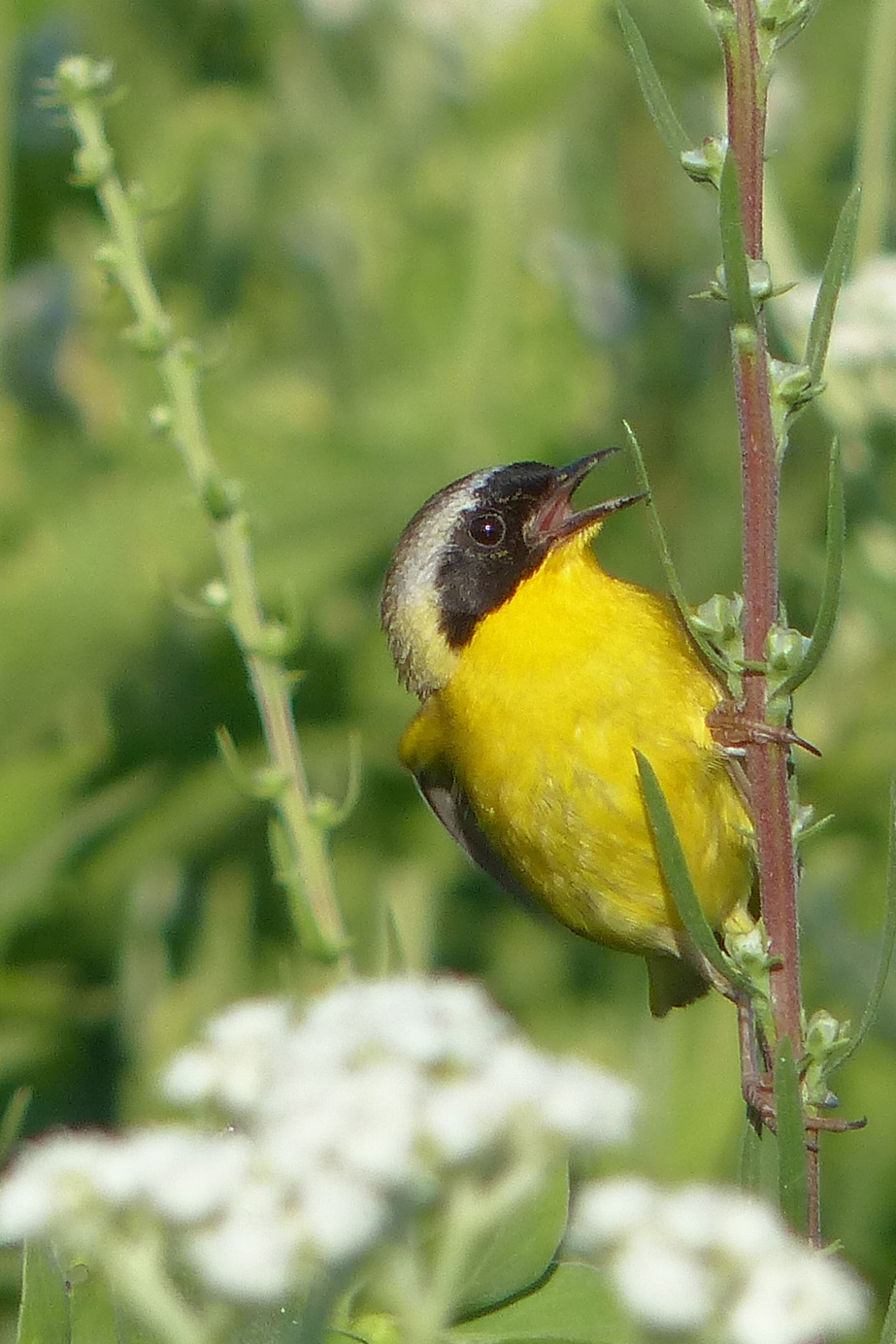
Why is this bird following me?


When you're
working in
an ecosystem
day after day,
many animals
get kind of used to you.

They treat you
as they would a deer.

In other words,
they don't pay
much attention.

But Lisa Culp
found this yellowthroat
to be following her around.

Was it trying
to be friendly?


Lisa is a steward
to Somme's 
important population 
of the federal endangered
prairie white-fringed orchid.


You can see the orchid 
in bloom 
inside the cage here. 

(For more on our efforts 
to conserve this plant, 
check out our blog 
"Leave Nature Alone?" 
from September 2012.)


For weeks, 
the intrepid Lisa 
has spent long hours 
of slow, detailed work 
in many of Somme's 
yellowthroat territories, 
caging, pollinating, 
and monitoring 
this extremely rare plant. 

In all this time, 
no yellowthroat 
has talked to her, 
followed her, 
and stuck with her 
as did the little character 
shown in these photos. 
What's with this bird? 


The yellowthroat 
is a warbler that is 
seen and heard daily 
in all three 
of the Somme preserves. 

It's easiest to find 
by listening for its song "Witchity Witchity Witchity Witchity Witch!" 

It sings off and on 
all day long, 
most often in the early morning. 

When you hear that song, 
watch for movement 
in the vegetation 
and train your binoculars 
on the first thing that moves. 

Look for the 
bright yellow throat, 
of course, 
topped off by a black mask 
with a gray highlight above it. Note the thin, pointed bill.

It's busy and curious, 
though normally 
a bit nervous and shy. 


One rewarding angle 
of yellowthroat watching 
is that it forages 
among the rare prairie 
and savanna wildflowers 
that we have come 
to learn and love. 

As it hops and flits 
from plant to plant, 
once you've learned to 
recognize them at a glance, 
the bird puts its little spotlight 
on species after species. 

Here it's on 
a bud-covered stem 
of "gayfeather" 
or "marsh blazing star." 
In a couple of weeks 
this stalk will be a magic wand 
of brilliant pink-purple.

The yellowthroat treats it 
as just a landing pad 
and opportunity to find 
bugs to eat. 


Here's "the  bandit" 
(a pet name for the 
masked yellowthroat) 
in the middle of 
a wild quinine plant. 

Like the blazing star, 
wild quinine was absent 
from most of Somme 
before we started gathering 
and broadcasting 
its seed. 

One time we found a big and beautiful moth that hung out on this flower. We wondered 
if it was specially adapted to it. We never saw it again.

It is fun and a challenge 
to learn to recognize 
all these rare flowers and seeds, and their animals 
and to be good stewards of them - to restore their diversity 
and health. 

We are inspired 
to think about the discoveries we haven't made yet - 
to imagine we'll find 
that moth again some time, 
and photograph it, and study -  
and who knows what surprises we'll uncover? 

Here the bandit perches 
on a dried stalk 
of saw-toothed sunflower.
The dead stalk reminds us 
of last year.
Ripening seeds 
remind us of next year. 

Each element 
that the yellowthroat spotlights 
reminds us of another facet 
of the complexity that we find 
so compelling 
about this intimacy 
with our ecosystem.

In many of Lisa's photos, 
the bandit is balling her out. 
Does this guy follow Lisa 
because his babies are nearby? 
It's likely. 
Many birds chirp 
for all they're worth 
when a big mammal 
comes near nest or babies. 
This time of year, 
the chicks may be scattered 
over quite a distance.
But each one deserves 
to be protected. 
He is bold in defense
of his babies.


Here he balls out Lisa 
from the stalk 
of the rough blazing star. 
This species blooms much later 
than "gayfeather."

By then 
the un-masked 
and subtly-colored 
female yellowthroat 
and her masked male partner 
will likely be working 
on their second 
nest and family. 

Yellowthroats 
feed the chicks 
for a longer time 
than most warblers. 
They'll likely 
still be feeding 
and protecting 
the next generation 
when they start 
to migrate toward 
the Caribbean islands 
or Central America in fall. 


Here's a clue.

When they ball you out 
with a bill full of food, 
they're definitely wanting 
to feed their babies.

"Get out of here," he chirps. 
"I want to feed the kids, 
but I sure don't want 
to show you where they are. 
Go! Scat!" he says, 
as best he can. 

When he comes this close, 
it feels like he's being friendly. But it may be 
the opposite.


In her note that accompanied these great photos, Lisa wrote, "I didn't follow him ... he followed me." I know the feeling. We enjoy their presence so much that it's hard to say good-bye, though both the bird and I are relieved when an encounter like this ends. 


Finally, 
Lisa's work 
moved her away, 
and the bandit 
stayed behind.

What a pleasure, 
to be able to share 
these sweet intimacies 
with the blogosphere. 

Thank you, 
computer geniuses.
Thank you, America.
Thank you, 
Forest Preserve District 
of Cook County. 
Thank you, Lisa, 
for capturing 
all this richness.

Thank you, little bandit.

And thanks 
to everyone who 
comments on this blog, 
or passes it along to others, 
or just appreciates it.

It's nice to share with you.

Tuesday, June 25, 2013

The Evil of Cowbirds


A big parasite that persecutes a beautiful rare songbird. For nature-lovers, it can be hard to take. Why torture delicate rare birds? For that matter, why burden people’s sensibilities by writing it up in a blog? And yet, sometimes by facing wickedness, we can understand it, and disarm it. 

Yesterday I saw something wonderful and (to me) scary. The first orchard oriole nest I ever found was high in an isolated elm, surrounded by a meadow of rare flowers and grasses. The orioles seemed to be defending their nest from a female cowbird, even though there were babies crying from the nest.

  
The big fat, ugly baby on the right has likely killed two or three young orchard oriole 
siblings like the one on the left. Be still, my heart!

A LITTLE BACKGROUND ON COWBIRDS
A while back I had arguments on this subject with a wise and wonderful bird conservationist, the late Jerry Sullivan. It was Jerry who developed the monitoring protocols now used by the Bird Conservation Network. Indeed, he developed them at Somme Prairie Grove, where in his years of work, while the restoration was in its early decades, he never saw a single orchard oriole. He would have loved to see them and their babies. He might not have liked this write-up.

I told Jerry that when I happened across a birds’ nest with a cowbird egg in it, I took out the cowbird egg. To me, it was like weeding a garden. Cowbirds are nest parasites that under modern conditions are pushing some bird species toward extinction – and vastly reducing the numbers of many others. “Why shouldn’t I help the species that need it?” I asked. As best I remember, Jerry felt strongly but was uncharacteristically inarticulate about why not. “They’re nature,” he said. “How do you know the result? Leave them alone.”

WHY ORCHARD ORIOLES ARE SO PRECIOUS
The nesting orchard orioles at Somme are a confirmation of a precious hope – that if you successfully restore a natural ecosystem, the now-rare animals of quality ecosystems will come back. (Well, perhaps I should write, “at least it may attract the rare animals that can fly and that still survive somewhere within flying distance.”) In other words, the orchard orioles that annually breed here confirm the quality and meaning of Somme Prairie Grove. In doing so, they affirm what some of us have been devoting much of our lives to for three plus decades. 

Unlike the much commoner Baltimore oriole, the orchard oriole breeds in savannas, not suburban neighborhoods or forests or prairies or anywhere else. (Actually, before the days of pesticides, they regularly bred in orchards, which are savanna-like in that they consist of scattered trees in grassland.) Since this species evolved to breed in a specialized habitat, without a place like the savanna at Somme, there would be no young orioles to carry on the species.

And it’s not just this species. Many shrubland and savanna birds (and butterflies, snakes, wildflowers, grasses, etc.) now breed merrily at Somme: among the birds - Woodcock. Black-billed cuckoo. Ruby-throated hummingbird. Eastern kingbird. Great crested flycatcher. Wood pewee. Northern flicker. Yellowthroat. Warbling vireo. Eastern bluebird. Rose-breasted grosbeak. Indigo bunting and many others. Some of these now or in the past have adapted to our culture’s farms, neighborhoods, or roadsides. But then come changes (mowing, pesticides, etc.), and the birds need to fall back on the nature they evolved in. Conservation land is increasingly critical to many of the species that now have babies or set seed each summer in Somme Prairie Grove.

LISA’S PHOTOS TELL THE TALE
When I texted Lisa with my discovery, she raced there with her camera. Most of the rest of this story is well illustrated by the photos that she took yesterday. 


This baby oriole 
on the branch 
hatched from an egg 
in the nest above. 
The hanging structure is beautifully woven of strong fresh grass and lined with fine grasses and plant down. The oriole mom lays four to six eggs and incubates them to keep them warm. Unfortunately, in this case, and many cases, the female cowbird sneaks in unnoticed and lays one big egg of its own. The female cowbird is too busy to help incubate or feed, because she on average lays 40 eggs per year in nests of other birds and races around protecting her eggs and young and chasing other female cowbirds 
from her territory. 
She's busy.


Ahhh! 
The female oriole has arrived
with a fat grasshopper. 

Who’ll get it? 

The cowbird is the one 
with the big mouth. 
Can you see the baby oriole? 
(Hint: the cowbird 
is standing on it.)

Now the mom is ready with the food. Babies need a lot to grow feathers and strength enough to fly and avoid predators. Guess which chick is going to get this meal. Hint: cowbirds are evolved to win this contest. Once “cow” birds followed herds of bison, which is why they couldn’t hang around to take care of junior. They are evolved to find their food in the short grass where the bison have been grazing. These days they find it in lawns, so they can stay put and defend territories.


Let’s see here. One of 
the best techniques is just to step on the head of the competition. 
The baby orchard oriole gets fed only when the parents bring food so fast that the cowbrat is too stuffed to choke down any more. 
Earlier, the cowbird parasite may use its big butt to push baby orioles to the side of the nest, and then up, and out, so that they fall to their death. Later some babies will just starve because Mr. or Miss Greedy-kins pigs up all the food.


Here’s the male 
bringing a juicy worm. 
When the orioles are successfully raising four or five (to as many as eight) of their own real chicks, sometimes the male and female each tend a sub-family of two to four chicks. When fledged, the chicks and their chosen parent can then wander to a part of the preserve where food is more plentiful.


Ahhhh! Finally, 
the baby oriole 
gets some grub. 
One surviving chick 
is better than none.

We wish this little one good luck. 
In time, the orchard orioles may evolve their own defenses against cowbird parasitism as some other species have done. Some species have learned to throw the intruder’s egg out of the nest. Some species recognize that the parasite’s egg is evil (from their perspective) and build a new bottom to the next on top of that egg, so that it doesn’t get incubated and never hatches. But evolution takes a long time. The orioles might need a bit of help (like habitat restoration to increase their numbers) if they are to accomplish such an evolution.   

Good luck, little oriole!

END OF STORY

But below are a few more tidbits about orchard orioles and cowbirds, if you'd like.

"MAFIA BEHAVIOR" 

I have to admit that Jerry Sullivan’s concern about removing eggs did trouble me. Am I wrong to “play God” with this egg removal? Am I counterproductively slowing the evolutionary process? Or perhaps am I causing some other kind of unexpected harm? How could I know? So I kept confiscating cowbirds eggs on the occasions when I found them – somewhat confident that I was on the side of the good.

One day, walking through Vestal Grove at Somme I noticed a female indigo bunting building a nest beside the footpath. “Nice,” I thought. “I can keep an eye on this one. Perhaps get some good photos.”

Next day on my way into the preserve, I noticed a pale and pretty little bunting egg in the nest. On my way out of the preserve two hours later I checked again, and the little egg had been joined by a big speckled cowbird egg. I removed the later.

Following morning I checked again, and the bunting’s egg was lying on the ground under the nest, punctured by a peck of some evil bill. Hmmmm. I suppose this is one option Jerry was thinking about. Cowbirds do guard nests where they’ve laid eggs and sometimes throw out the original egg if something happens to their own. Purpose? To get to owner to start laying a second time. The cowbird doesn’t want the other bird’s eggs to hatch first and "get ahead". If the parasite’s egg is laid at the same time as the host’s, then the fat cowbird egg (which hatches a bit quicker than other birds’ eggs) will be assured the head start that will make its chick big enough to be the bully.

A day later there were in the nest one bunting egg and one cowbird egg. I considered another approach. I could let the next cowbird egg stay in the nest until ready to hatch (in as few as 10 days for the cowbird, 12-13 days for bunting eggs) and take out the cowbird egg at the last minute. Perhaps the cowthug wouldn’t still be watching?

But next day the whole nest had been torn and ravaged as if by a raccoon and both new eggs were gone. So I couldn’t find out.

Wikipedia says: “Cowbirds periodically check on their eggs and young after they have deposited them. Removal of the parasitic egg may trigger a retaliatory reaction termed "mafia behavior". According to a study by the Florida Museum of Natural History published in 1983, the cowbird returned to ransack the nests of a range of host species 56% of the time when their egg was removed. In addition, the cowbird also destroyed nests in a type of "farming behavior" to force the hosts to build new ones. The cowbirds then laid their eggs in the new nests 85% of the time.

But what if the egg is removed toward the end of incubation? And was that female cowbird I saw at the nest really interfering with the nestlings, as the commotion suggested when I first saw this nest? According to some studies and anecdotal observations, cowbirds do sometimes attack the nestlings that are competing with their own little freeloaders.

WHY DOESN’T THE MALE IN THE PHOTOS ABOVE LOOK LIKE HE’S SUPPOSED TO?


If you look up “orchard oriole” in the average bird guide, the male will be a handsome combination of black and deep brick red – not the mix of yellow and reddish that the male bringing food yesterday displayed. What gives? Atypically, in this species first year males have a distinctive coloration, much like the female, but with black markings on the head. Why would that be?

Here’s a theory: maybe females want a good way to distinguish older males, possibly because they’re better at the challenges of raising babies. 

When orchard orioles started nesting at Somme, they were first-year males. Maybe that means that Somme was still somewhat of a marginal habitat. Or it might just mean that birds like to return to the successful habitats where they were raised, and the mature ones secure all the territories there. So it's the young who venture to try new sites. In any case, in later years the mature males class up Somme with their proper colors.  

Bonus photo:

In 2023, Lisa photographed this "poor female yellowthroat feeding a you-know-what." 

Historic note
Most birds are poorly adapted to dealing with cowbirds because they were once a minor presence around here. Cowbirds followed herds of bison; they're adapted to feeding in the short grass where bison grazed. Because they had to follow the herds, they couldn't stay behind to be proper parents. Thus they devolved into heartless parasites. These days the forest preserves have no bison herds, but they are adjacent to thousands of acres of mowed lawns. Such lawns are now the cowbirds habitat and support so many of them that these freeloaders are a substantial cause of ongoing declines of many songbird species. Do we really need such massive acreages of lawns? 

Credits
All photos by Lisa Culp Musgrave … except for the mature male oriole from ms.audubon.org by Bill Stripling.

Note on the language
It has not escaped my attention that this blog uses intemperate and slangy language. For some emotional reason, it seemed like a good idea in this case.