Friday, September 07, 2012

Leave Nature Alone?


                                              “O sweet spontaneous

earth how often …
has the naughty thumb

of science prodded

thy beauty”
                                    e.e.cummings

How much meddling with the ecosystem is too much?
Or, to look at the flip side, when does “leave it alone” become shameful neglect?

This is a report on the prairie white-fringed orchid (Platanthera leucophaea) at Somme Prairie Grove. It’s a drama of a threatened species coming back from the brink.

Under modern conditions, neglected populations of this classic prairie species die out. Without our help, this orchid (and many, many species) would soon be gone from the Earth.

My adventure with the orchid began in the late 1970s when I was just starting my career. I got a report that a young fellow had found it in a forest preserve. Rufino Osorio grew up in a rough and crime-ridden inner city neighborhood, but his grandmother in Puerto Rico had introduced him to the love of plants. In Chicago, he figured out that the Montrose Avenue bus would take him to Schiller Woods Forest Preserve along the Des Plaines River. It was an Eden to him, in many ways. But when he found the orchid, he had to tell somebody. Rufino called the Audubon Society, and they put him through to me at the Illinois Nature Preserves Commission.

Did this kid know what he was talking about? The orchid blooms for just a couple of weeks. Rufino gave me directions.

I went. I saw. I was in love.

I organized volunteer expeditions to Schiller Woods to cut back the brush that was threatening to shade these beauties out ... and snuff the whole prairie community there. We did great work, but we noticed that the orchid rarely set seed, and its numbers were diminishing.

Then, out of the blue, Marlin Bowles of the Illinois Department of Conservation dropped by my apartment with a white-fringed orchid sticking out of a 7-Up bottle. It had been broken off by accident, and he’d rescued it, he said, for scientific purposes. Sure enough, it was destined for greatness, because he used it to teach me how to perform one of the great intimacies of nature.

PHOTO CAPTION: This gorgeous flower is brilliantly functional. The nectar is at the bottom of those long tubes that curve down from the back of the flower. To find out why, read about "playing-hard-to-get" orchid sex, below.

Reproduction among the orchids is otherworldly. Only a few species of hawk moths can pollinate this one. The pollinator needs a prodigious tongue, because the orchid plays hard-to-get with its nectar. There’s a huge amount, but it’s at the bottom of a tube that is longer than the tongue of any bee or butterfly or hummingbird or almost any moth.

Marlin knew why the Schiller Woods orchids produced little or no seed. Pollinators are few, and the moths rarely find the orchids. When a moth does find the flower, it backs up, unrolls its tongue, feeds that long tongue down to the bottom of the nectar tube and drinks. It also gets a pollen packet stuck to its head or the base of its tongue, and flies on the to next plant (where conception now occurs).

Marlin taught me (and I subsequently taught many other volunteers) to mimic the moth with a toothpick. Once you have the pollen packet stuck to the pick, you go to another orchid and press it against its “stigma” – a sticky patch just above the opening that leads to the nectar. When you do it right, the stem of the pollen packet stretches accordion-like until the now-sticky pollen pops back from the sticky stigma, ready to meet the ovaries of the next flower. It’s hard to describe, but it’s incredibly gooey, elegant, and sexy. And it makes baby orchids.

PHOTO CAPTION:
As this toothpick draws back from touching the sticky “sigma” – one pollinium’s stalk is stretched way out. The other pollinium on the toothpick, which didn’t contact the stigma, shows what both had looked like, seconds before. To an orchid, would this photo be pornographic?

Rufino and I and our pals in the North Branch Prairie Project wanted seed – so that the orchids could have a chance to reproduce in the many prairie patches where we were cutting brush and restoring diversity.

Orchid conservation isn’t for people who require instant gratification, beyond the sex part. It was five years before we saw the first results from our new seed. After four years of nothing, I frankly wasn’t thinking much about orchids in July 1985 when I got a call from insect researcher Ron Panzer.

“Packard, you’re a genius,” he announced. I asked for detail. He reminded me that he’d first thought Somme Prairies Grove was ecological junk, but now, on return visit a few years later, he was finding many rare insects and plants including, of all things, the prairie white-fringed orchid.

He assumed I’d already seen them. I had not. He gave detailed directions, and I raced up there the next morning. Now comes the start of our next chapter – betrayal, evil, tragedy and restoration.

There was no orchid where Marlin told me to look. The directions had been simple, and you can’t miss it. Only one explanation was likely. White-tailed deer eat (and in some cases completely wipe out) many endangered and threatened plant species. They especially like orchids.

In 1986, I prowled the spot Ron described and found four orchids in bud. Oh, Yes! In 1987, I found three – and more at other North Branch sites where we’d scattered Rufino’s seeds. A successful restoration experiment?

Those were busy times for me, and I didn’t get a chance to see whether these plants successfully escaped the deer, attracted moths and set seed. In 1988 I found zero. Okay, nature can be like that. But in ‘89 and ’90, also zero. In 1991, blessedly, there were four plants. Then in 1992 – another zero. Success? Failure? Which would it be? The next year would be the start of a whole new chapter.

For this account, I checked 1993 in my restoration journal; I found not a word of the orchids on any summer date. But in the back of the journal, where the special species counts are, under its scientific name, I find the entry “3*”. And at the bottom of the page next to the * are the words “put in chicken-wire cage for protection from deer.” I had found three and caged them.

Has it come to this? The orchids in little prisons? But this was at least a stop-gap measure to ward off local extinction. Those three or four orchids we were seeing on some years now would have a chance to start a population. They started to benefit from three different types of “meddling.” First – the cages. Second – hand-pollination of every plant every year. The third was the hardest: with many others we worked to achieve public recognition of deer over-population. Both the Village of Northbrook and the Forest Preserve District began culling to bring deer numbers into balance with the rest of the ecosystem.

There was also an amazing vote of confidence from the U.S. government. The Fish & Wildlife Service began work to protect this endangered species. It was declining most everywhere – except the little North Branch sites where we volunteers were tending it. Fish & Wildlife contracted with The Nature Conservancy (where I then worked) to replicate this success at many sites in northern Illinois (the heart of the plant’s range). I was honored to see the initiative started by Rufino and me adopted as a model. I also looked at our encouraging, but really rather feeble, success data and whispered to myself under my breath, “I hope this really works.”

(There’s an important side note here. No one was caging the orchids at Schiller Woods. Deer numbers there were very high - and orchid numbers decreasing. No orchids have been found at the site where Rufino had first discovered them since 2003.)

Summary of Phase 1: During the twelve years including 1986 through 1997, we found no orchids in five of those years. In the other six years we found a few, with a twelve-year average of 1.8 orchids per year. This may seem a pathetically small population for all this history, but just you wait. The key fact was that orchid habitat was here, and these plants (22 over the 12 years) were each making 50,000 to 100, 000 seeds per year (once the deer weren’t eating them). In other words, perhaps one million tiny endangered seeds were floating through the air and landing in potential habitat.

Orchids have seed like dust, designed to blow in the wind. The seeds are so small that they’re barely visible to the naked eye. No seed coat, no “germ,” no structures of any kind. Just a few undifferentiated cells. When the wind drops one in the dirt, another drama starts. A specialized fungus must infect it, as if to devour yet another piece of soil detritus. The orchid seems not to resist this assault – but it uses judo. Soon the fungus finds that, instead of gaining nourishment, it is losing it. The orchid is eating the fungus.
Daniel Suarez braces his hand on a green metal post. It held the 
deer-proof cage he has removed briefly to pollinate. Posts? Cages? 
Toothpicks? Is this too much prodding and poking?

An orchid initially lives for years entirely underground, like a mole, or a fungus-y thing that only vaguely remembers its green parent plant soaking up the sun with photosynthesis. The plant consists of a root only. But it is a root that grows bigger each summer. It builds up resources until, three or more years later, it decides it’s ready to put up a green leaf and start competing with the regular plants.

Some orchids live a long time. Not this one. White-fringed orchids glory in only a year or a few of knock-out flowers and then die. It’s those hundreds of thousands of seeds that live on, if given a chance.

Of course, that’s a challenge for us stewards, because we never know where to put cages until the deer have had way too much opportunity to find those sweet little orchid leaves. So now comes another kind of pampering. We search for and cage them in May when the first shoots emerge.

Phase 2 of the Somme Orchid Drama represents a clear step forward. During the ten years from 1998 through 2007, we found orchids every year with an average of 8.2 per year. We found them in three other parts of the preserve. Now four little sub-populations were broadcasting their millions of seeds. (To put our numbers in perspective, in 2006 the U.S. Fish & Wildlife Service found a total of only 109 plants spread over more than thirty sites in northern Illinois.)

Immediate gratification? Just fifteen short years from the start of intensive restoration in 1993? Hey, this is getting exciting. 

Before I give the results through 2012, here's a summary list of the kinds of meddling or pampering we did:
  •        Ecosystem restoration for the donor population
  •     Hand pollinating the donor population
  •        Harvesting and bringing seed to the restored site
  •        Years of overall habitat restoration for the new site
  •        Hand pollinating the new plants
  •        Seed dispersal in areas we select, throughout the new site
  •         Caging from the deer
  •         Deer culling
  •         Caging from voles (Those little rascals cut the bottoms when deer couldn’t cut the tops.)
  •        Watering (when we had a chance to) during droughts
  •        Sampling and analysis to help decide how many plants and flowers to pollinate
  •        Controlled burns approximately every two years
  •        Pulling or herbiciding invasive weeds
  •        Cutting and stump-treating invasive shrubs and trees
A person could argue that we were weakening the population with all this coddling. But natural selection is a powerful thing, especially with all those millions of seeds. Any weaklings drop out. 

So - results. The graph shows numbers of plants through 2012. Note that we had to change the scale of the graph: 


Is nature better off if we leave it alone, or if we’re good stewards?

For me, this graph answers the question, at least for this species ... at this site ... so far. 

In 2012, at Somme Prairie Grove, we had 345 plants in seven major subpopulations. In addition, the orchids are popping up in odd corners all around the site, whether we’ve scattered seed there or not. This is now one of the world's largest populations. Will it be robust year after year? Only time will tell. But the first thirty years of our stewardship are looking pretty good. 

Helping nature recover makes us happy.

Endnote

Small populations may not have sufficiently robust gene pools to survive. To continue to evolve in the face of a changing world, some experts believe that a population of at least 1,000 individual plants is needed. The expert committee that advises the U.S. Fish and Wildlife Service on this orchid decided, after long consideration, to move pollen between sites. That action makes the effective populations much larger. The Somme Prairie Grove population has received pollen from many other sites, and - being one of the largest populations in the world - has contributed pollen to a great many others.

Acknowledgements

Photos by Lisa Culp Musgrave who has also coordinated much of the pollinating, caging and monitoring since she joined the Somme Team in 2008. Lisa is now a respected member of the U. S. Fish & Wildlife Service's orchid recover program. She has done "how to" presentations at conferences and trained many new "orchid stewards." 

Rufino’s website: http://rufino-osorio.blogspot.com/

Sunday, August 26, 2012

Fear of Bears


A wilderness with grizzlies is different from a tamer wilderness with just bees and snakes.

A week earlier, I sat on a Toklat River bridge watching a grizzly follow my trail. Then on August 24th, that bear (or one of a dozen others in the area) killed a backpacker who didn’t follow the park’s “Bear Aware” rules.

Denali National Park in Alaska is well run. Park Service rangers and guides repeatedly emphasize bear, wolf and moose safety. For bears, stay two football fields away. If one emerges from a closer thicket, stand tall, say “Hey Bear!” in a loud but calm voice. If a bear approaches you, wave your arms above your head to make yourself appear bigger. Talk firmly but calmly to the bear. (For a wolf, in contrast, use the tone you would with a bad dog.)

Rangers apparently try to reassure us by explaining, over and over, that most bear charges are merely to test you. If you stand firm, most bears veer away at the last minute. Reassuring?

They also offer this advice. If a bear “makes contact,” lie down and play dead. Keep your backpack on if you’re wearing one, because the bear may gnaw on the pack without hurting you. Adopt a fetal position. Lace your fingers behind your neck, as that will provide some protection there.

I found the advice less and less reassuring as these tutorials proceeded. That may have been the rangers' intent. Next was the contrast between grizzly and black bear attacks. Black bears are likely looking for dinner so I should fight back. Denali grizzlies are largely herbivores and will most likely attack because they're startled, to defend blueberry patches or for other non-carnivorous reasons.

Rangers didn’t give us pointers about how to fight back. To me the very least reassuring advice was the added detail offered by some rangers. “If a grizzly does start to eat you, then fight back.”

I was in Denali to appreciate the ecosystem. I saw three grizzlies, caribou, golden eagles, arctic ground squirrels, bear-flower, gentians, monkshood, reindeer moss and at least a thousand other species of plants and animals, most of which I couldn’t identify to species but all of which added up to an inspired bliss.

I dearly love the richness of life in true wilderness. Coral reefs, tallgrass prairies and alpine meadows are favorites. The overwhelming variety of color and shape gets to me. 

My partner Linda took photos of our first bear from the safety of the bus. Private cars are banned. Wilderness could not abide the traffic that would jam the park's one road. Color coded busses take hundreds of people a day down the 92 miles of unpaved inspiration. The green eco-busses are the best. They’ll drop you off wherever you ask and pick you up whenever you hail them.

We'd signed up with half a dozen other wilderness fans for a hike led by a park guide. She had intended to take us down a mostly dry river bed, across dead rocks, with a brief excursion to an “alpine meadow shelf” at the end. We abandoned the planned route in part because this was one of the about three days a month when Mt. McKinley emerged from the clouds, and views of it seem to be much sought after. Our guide also probably noticed three of our little group, on hands and knees, thrilled by our first glimpses of the miniature flora. We took a vote, and she led us, trampling across this precious landscape, to a high ridge where we saw the mountain. Later she’d map the hike; not more than two hikes a year can cross the same ground in this six million-acre park. The tundra recovers slowly from trampling. Wilderness is foremost.

Golly how awed I am by the magic of an alpine meadow. We puzzled over gentians, saxifrages, betonies and identified many of them from a picture book our guide excavated from her standard guide backpack. Also in that pack, an emergency radio: she taught us how to use it in case she was incapacitated. She assured us she would stand in front if a bear approached. She described her personal hair-raising encounters with Denali bears, all of which ended well.

One large and showy herb we found was bear-flower. Grizzlies dig it up to feast on its potatoes or carrots or whatever lusciousness it grows below ground. We saw much bear-flower, and many yard-wide diggings scattered wherever the plants were thick. We saw bear tracks, bear scat, and more bear-flower holes.

Our revised plan was to circle down into the river valley after our glance at Mt. McKinley. As we indeed circled, we increasingly noticed that buses of all colors were stopping on the bridge where we’d been left off. There was an expanding traffic jam of public transportation.

Busses stop in groups for one reason -- wildlife. Phalanxes of binoculars in bus windows pointed down the valley that we could not see but were heading for. “Perhaps there’s a fox,” our guide said cheerfully. It did not seem likely that foxes would cause such a jam. Our guide reminded us once more of Bear Aware rules. As we approached brush patches she called out “Hey, Bear” – again and again. She pointed out that grizzlies seldom confront large groups (we were seven).

Indeed, we reached the river without incident. We hiked upstream over the dull rocks, had lunch amid soaring peaks and floating golden eagles. We thought we’d finished our adventure with our retreat back downstream as we sat on the bridge for more than a half hour waiting for our green bus.

It was not a dull half hour. Soon after we sat down, a grizzly emerged from one of those thickets we had Hey-Bear-ed our way through. We watched as it dug up the bear-flower in the very patches we had appreciated. We could see where our hike had gone. The bear was following exactly in our tracks.

This bear was not close. It was more than two football fields away. At that distance, even a large bear is hard to see without binoculars. The route of the bear was essentially perpendicular to where we now sat. Our guide said, if it turns toward us, we need to back off. I found that hard to believe. Did we really have to retreat from an animal so far away that the naked eye could barely make it out? But the park has rules. Two football fields. Caribou cannot be approached closer than 25 yards. The varied distances seem to be based on the needs of wilderness. Our closeness cannot be allowed to impact the animals’ behavior. Caribou, apparently, are not easy to impact.

In time the bear went over the mountain, and a bus arrived to pick us up. Our guide said, “It’s a different experience to see a bear from outside a bus. Yes?”

The experience stayed with me. I began self-consciously hollering “Hey, Bear!” whenever I approached a thicket or turned a blind corner. Days later Linda and I hiked another alpine meadow far away, with no bear scat, tracks or diggings. It seemed less wild. I felt more relaxed. A different, more peaceful sense of closeness with nature returned.

On August 24 Richard White of San Diego was killed and partly eaten. Rangers responded to a report of a ravaged backpack and blood. They found a camera and the body; they shot the bear eating it. White's camera told the story -- the grizzly grazing peacefully about about 50 yards, then turning, and walking toward the camera. White photographed; he did not stand, speak with a loud but calm voice, and back off as required by the permit he had signed. 

I have learned to love the midwest's wild woods and prairies, that have been without grizzlies for many decades. I campaign to enlarge and restore them, to return them to the wildest state possible. I support bringing back natural predators as much as possible. Or do I?

This drama challenges me. I appreciate wilderness without fear very much. 

Tuesday, August 21, 2012

Weed? Alien? Invasive? Malignant?


Definitions can change the way we see the world – and how we act.

What is a Weed?

Weeds in nature are valuable plants that deserve respect. Be clear that the ecological definition of “weed” is different from the gardener’s definition.

In the photo below by Mark Baldwin, the black-eyed Susan is a native weed, and the blue chicory is an alien weed. They’re both good.

A weed patch in the ecosystem often functions much like a scab on a mild wound that you or I might suffer. Weeds are an ecosystem’s response to degradation or disturbance. The scab helps the wound heal. Weeds help ecosystems heal. They prevent erosion and begin a succession process that, in the best case, will end with the conservative plant species that were there before. 

Weeds are often annual or biennial. Classic native prairie weeds include ragweed, black-eyed Susan, and common evening primrose. These days, the “healing scab” species may also include weedy aliens like wild carrot, bull thistle and chicory. These “alien” species are long naturalized to North America and function like the native weeds. They should not be seen as problem species. A true simple classic weed goes away with time and doesn’t leave a scar.

Many people worry needlessly (and sometimes counterproductively) about weeds in restoration areas. Relax. Welcome them. Some people say authoritatively, “Oh, yes, wild carrot is a problem. I’ve seen it be very invasive.” But they haven’t. They’ve seen it become very common. That’s just a phase, and a step forward for the ecosystem. All these species are easily outcompeted by more conservative prairie species within a few years.

Spraying herbicide on wild carrot or bull thistle may kill it. But that same herbicide will also likely kill young plants of more quality that would otherwise have soon out-competed the weed. In response to herbicide, the same weeds – or possibly more damaging invasives – may well fill the herbicide-created void, instead of the young prairie plant that otherwise would have been thriving in a year or two. Even pulling harmless weeds may slow down the restoration, because it takes time away from work that would actually do some good.

What is Invasive?

Simple weeds do not lead to the damage that an invasive does. In the early days of ecosystem restoration, we often misused the word “alien” as the standard word to describe species that degraded ecosystems. At first, that word seemed to communicate well, as many people quickly supported the need for remedies when it was used. “Alien” was partly accurate, since most of the problem species then recognized were from other countries. Many members of the general public (who were basically too busy or not interested enough in ecosystems to spend a lot of time learning about problem plants) seemed to feel like they understood what we were talking about through the metaphor that mixed the fun fear of space aliens with the now-politically-incorrect-in-progressive-circles concern about “outsiders.” 

But that word failed for two reasons. The first was that some people increasingly used it as an opportunity to argue politics. Attempts at scientific discussion were regularly hampered by totally unrelated Republican-Democrat arguments, especially as America became increasingly divided over the “undocumented.”

More important, it became increasingly clear the “native” and “alien” wasn’t really the issue. Most non-native species were no problem. And many native species were very much so, in the modern context. Unburned prairies died in the shade of native gray dogwood or green ash as surely as they did from the shade of alien buckthorn.

Many of us started using the word “invasive” for what we once called “weeds” or “aliens.” This approach worked better. It described the real problem better (but not good enough).

In savannas, although gray dogwood or sumac could indeed degrade the system in the absence of fire, they did not “invade” from outside. They were natural components. Yet they could be lethal to the basic ecosystem. Similarly with animals, overabundant meso-predators can seriously damage systems they were a part of, in the absence of large predators.

We began to recommend using “in balance” and “out of balance,” but many people found the “balance of nature” concept also “out of date” and misleading.

Benign and Malignant

Increasingly, many of us have begun to compare the health of the ecosystem to the health of the human body. It’s a fairly easy model for most people to understand. The parallels are substantial.

In this metaphor, the “problem species” is the disease microbe or the cancer cell. Just as a formerly perfectly respectable cell from my own body can start multiplying uncontrollably and kill me, just so, a formerly “in balance” member of a community can reproduce out of control and cause the lost of most species. That’s ill health, from a community perspective.

In the absence of fire, maples can invade a bur oak woods and wipe out most of the natural diversity of animals and plants. Okay – it seems fair to call that maple an invader or “invasive” in that scenario. But box elders and wild black cherries are constituents of oak woodland. Natural fire keeps them in check. In the absence of fire, those species create a malignancy of shade. How should we refer to them in that case? They didn’t invade. Perhaps “out of balance” and “malignant” are the best words our language has. 

Native white-tailed deer can drive out most species of wildflowers, shrubs and saplings from a savanna or woodland; they can also seriously deplete many bird species. They’re native, beautiful animals and have rights, but they also may have a malignant impact in the absence of equally admirable predators. As Leopold’s Land Ethic makes clear, ecosystems deserve our respect and affection – and they also have rights.

Conservation requires public support. Thus, we need good words to describe problems and solutions to people who care about nature but will not have time to study intensively. The goal of "reducing malignant species" seems both truthful and easy to understand.  

Wednesday, August 01, 2012

THE “Z” TREE

An ancient woodland lets you see long histories preserved in the shapes of the oaks, especially the bur oaks, like this one.

How did it get its craggy shape?

The answer will be speculative – but likely true.

At least two hundred years ago, another tree  grew just to the east (left in this photo) of this tree. That tree (now gone) became a big old monster, and the Z tree was shaped by its shadow. As that long-gone oak grew and spread, the younger Z tree began bending to the west, to get at least the afternoon sun.

Then something dramatic happened – at just about the time when the second big branch was forming. The big tree died, or was blown over, or got chopped down. 

At that point, huge light was available to the east, and a new trunk-like branch headed straight left to soak it up.

Great job, tree! Some of the history of an ancient tree can be openly revealed in its architecture. There’s something righteous and moving in how the struggle, determination, and triumph of this bur oak was thus preserved.

This tree of noble character will be replaced by others, as its acorns find places in the sun. For now it's available for all to appreciate, on a little glacial rise near the beginning of the Outer Loop trail, in the southeast corner of Somme Prairie Grove.


Friday, July 27, 2012

Why the Finery?


If you run across flags, 
or ribbons 
or even elaborate stuff like this in the woods, 
please don’t mess with them.


They’re science. And science, contrary to some political figures these days, is pretty much good. In this case Northwestern University grad student Karen Taira is studying the pollination biology of perennial sunflowers.

She is beating the bees to the pollen. Indeed, using bridal veil material, she’s excluding bees, which are difficult to train as scientists. Karen and her colleagues are hand-pollinating different flowers in different ways and comparing the results.

Part of the goal of forest preserve conservation is to conserve gene pools, components of which may be important to the future of the planet, our grandchildren, and the health of our spirits. (In case you haven’t heard, people who actively or passively let the beauty and fruit of millions of years of creation and evolution go down the drain may subsequently suffer in hell – of one kind or another.)

In order to conserve biological diversity, it’s very helpful to know more about how species reproduce, evolve and change. Thanks to Karen for working on this.

For some related work by Karen Taira go to:
http://blog.lib.umn.edu/wage0005/echinacea/Taira%20MEEC%20poster.pdf


Thursday, July 26, 2012

MONET ON THE PRAIRIE


Or would a better title be “Under Construction”?

In fact, here we have “pastoral beauty” and “work zone” at the same time. The tension between to two is part of the kick.


If we had a few-years quick-video prelude to this sunrise scene, we’d witness heavy equipment ripping out drainage tiles and whacking trees and brush with more of a “macho” than “touchy feely” look. We’d see hundreds of happy people working hard in all seasons – building brush piles, burning them with towering flame, pulling weeds, gathering and broadcasting rare seeds.

This morning a few of us show up at 6 A.M. to be cool, with long-bladed scythes, to slay vegetation. The Heat Index will top 100 in a few hours; we’ll be gone by then. At 6 the air is the temperature of Heaven.

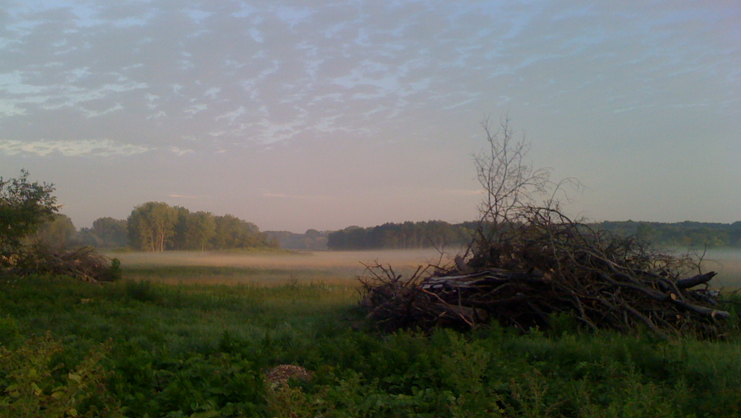
Looking like a Monet haystack, the brush pile was heaped up last winter with a grappling machine by John Yapelli, our beloved and gonzo eco-restoration tractor jockey.

See those whitish tall tree trunks in the distance? They’re an invading species. Two years ago those beautiful invaders extended all the way to the foreground and then on behind us. After next winter, there will be fewer. Perhaps you can tell, they’re on both sides of a slough, and they lined it for over a mile.

We cut them only after debate. Some rhapsodized about the sounds of their leaves. One expert cautioned that bats landed in them. But this landscape for thousands of years had been a mosaic of prairie and oak woodlands. It was beautiful then. It was also beautiful when the farmers turned the land to farm fields and wooded pasture. Monet could have painted either scene with equal beauty. But the aesthetic actually started going down hill when the Forest Preserve District “preserved” it to let it “go back to nature.”

Brush and weeds may have an integrity of their own, but there’s more to beauty than meets the eye. When colorful waves of purple loosestrife started wiping out the wetlands and destroying all habitat for ducks, turtles, terns, orchids, sweet flags and the rest of wetland richness, people used to say to me, “Well, you’ll have to admit it’s beautiful.”

“No I don’t,” I’d wearily reply. “I have to admit it’s colorful. But a black eye can be colorful, or an infected wound. When you know the meaning of what you see, it can inform your appreciation.”

This recovering prairie-wetland-woodland mosaic is beautiful to the ear through the calls of recently returned sandhill cranes, crested flycatchers, bobolinks, and meadowlarks. It’s beautiful to the mind in part through knowledge of all the smart and dedicated people who are restoring eco-health here. Blanding’s turtles have almost vanished in most places. We hope they’ll breed successfully again when less raccoon-filled brush stands between the slough and the uplands, where they want to lay their eggs.

Today with scythes we battle sweet clover, a malignant species that could wreck the habitat for diverse plants and animals. We stewards are a force of nature and, oddly, sweet clover is not.

Later more big machines will return to herbicide wide swaths of evil crown vetch and reed canary grass. Other big machines will haul trash and clear invasive trees so the sunlight can filter unimpeded through the scattered oaks and hickories. Nature is beautiful. And the restoration of nature has a drama and aesthetic of its own.

This is a vision. Can you see it?

Friday, July 20, 2012

DROUGHT AND RECOVERY

We had essentially no rain all this hot summer -- until today. The prairie was suffering badly. How do its plants react? In the photo below, from yesterday, many small plants have already withered away to invisibility.

The normally tenacious bastard toadflax covers most of the ground, but it's dropping half-formed fruits and letting the leaves go yellow, as it moves its resources back into its shallow but secure roots.

The biggest green prairie dock leaf (15 foot deep roots) is holding on for now, but the smaller dock leaf is cashing it in. 

In the upper center, the leaves of wild quinine are curling. Rattlesnake master (to the left of the dock) has let one leaf go brown and is starting on a second. The grasses (bottom: little bluestem. left: prairie dropseed) are still green, but they're not growing.
We get a similar story from the purple prairie clover and black-eyed Susan in the photo below:

The clovers normally have long flower spikes that bloom for weeks. These are short and only bloomed for days. Prairie docks in this lower, less dry area are keeping their leaves, but they will put up no flower stalks this year. Shallow-rooted black-eyed Susan is shorter than normal by at least two-thirds. Instead of a dozen or twenty flowers, it's putting out just one. Some species are invisible here, like smooth phlox, normally busy maturing seeds, this year withered back into dust.


Today we got three glorious inches of rain. For the ecosystem, it's a whole new ball game. But for me, I think back to how gloomy I felt. Is it just because so many seeds that we planted have died? Or because so many animals breathed their last from lack of reserves in the too-small habitat fragments that are all we have left them? Or is it merely that the lush richness I rely on to inspire me wasn't there for my emotional nourishment?

For most of my “adult” life I’ve welcomed depression as a rare and helpful visitor from another realm. It says, "Stop. Think. Get outside your usual rationality and actions. Re-boot. Rethink. Consider what to change, abandon, risk or begin."


Can droughts foster planetary depression? How do we get it across to the larger culture that global warming is not just some different weather but is an act of planetary vandalism worse than the Taliban demolishing ancient art and temples? Beyond losing cultural treasures thousands of years old, we will be and are losing ecological treasures hundreds of thousands -- and millions of years old. Our children will be poorer in so many ways.

Thanks to those three glorious inches of rain I look forward to being able to collect seed again -- and to watching the inspiration and fun of ecological recovery.

Although I only see bits of it on the global horizon so far, I also look forward to the fun of watching and helping smart and dedicated people figure out how to focus widespread ecological intelligence on the health of the planet.

Sunday, July 15, 2012

The Good, the Bad, and the Odd


This post is about, among other things, an evil weevil.

In the photo, four out of six compass-plant flower heads miserably droop and are brown.

"Who cares?" you might ask. But we were trying to restore health to nature, and we needed the seeds.

We had noticed plants like this and assumed that they were aborting their flowers because of drought. Good plant. Bad weather. 

But then we saw them again on a tour with botany guru, Dr. Floyd Swink.

He said, “A weevil does that. And yes, it’s a small  problem for the plant, but one it can handle." Then his pun kicked in: "Compared to the devastation caused by the boll weevil in the South, this one is the lesser of two weevils.”

Swink's mind was such that he had trouble talking without puns in every sentence. It turns out that the weevil bug cuts the stem and then lays its eggs in the hanging flower-head. Young weevils like to eat dying greens. Odd.

Indeed, the great Floyd Swink, first author of the Plants of the Chicago Region, was also odd. He was so focused on remembering millions of details of plant taxonomy that he was often clueless about most else. He was fired by the Morton Arboretum on the same shameful day that they fired Gerould Wilhelm and Linda Masters - the Arb's three passionate plant conservationists. His strategy over his decades of work - as one of the Arboretum's most respected scientists - was to keep his head down and study plants. After being fired, he continued going to work, which the administrators allowed, just not getting paid.  

Compass-plants too have strategies. Their roots look like giant forked carrots and go fifteen feet into the subsoil. You’d think these fat roots would have adequate reserves for most anything, but they don’t use their energy to bloom every year. One summer there’ll be lots of leaves but few or no flower stalks in the whole prairie. The next summer it seems every plant is putting up a forest of higher-than-our-heads massive hairy stalks and happy flowers.

Why? One possibility is the “periodic cicada principle” – in which a species reduces numbers of seed predators and pests by having few seeds or eggs most years. Then one year, with few seed pests left, they all blast forth with huge numbers of flowers/seeds/babies all-at-once. The sparse pests just can’t eat them all.

Such strategies are an impressive feature of rare conservative plants in healthy habitats.

Unlike weeds, do these conservatives worry about pests? Doughts? Ho hum. No. They're in no hurry.

In the ancient prairie, compass plants have reserves and confidence (and odd tricks when needed) 
to kick butt 
in their own quiet way.


Wednesday, July 11, 2012

A Death on the Prairie

Our hearts go out to animals with large eyes. It’s a human response, and we want happiness for them.

This will be a blog of gore and recycling that might be hard to take for some of us with sensitive souls. If you prefer to stick with the beauty and romance of nature, you might want to skip this one.

Any abandoned organic material in the ecosystem gets recycled. While we’re alive, our bodies’ defenses ward off the agents of decay. But a return to the ecosystem is a trip we all make, sooner or later. In fact, you accomplish a preview if you ever pee in a forest preserve. From that act on, a part of you will be cycling through the plants and animals there for a long time. If you eat a berry or a walnut from the preserve, a part of that preserve will become a part of you.

Piles of bloody feathers or the remains of a rabbit, perhaps a foot and some skin, are commonplace along the trails at Somme. Most local deer, shy and beautiful animals, die from collisions with automobiles. The death of a deer is a big event, ecologically. 

On the morning of July 3rd I head out, lugging four gallons of water for endangered orchids that deserved help to survive the drought. (Is that nature? Watering plants in the wilderness? I’ll reserve that question for another post.) But while innocently lugging water, I find the kind of nature that’s red in tooth and claw.

The body of a handsome young buck is lying near my path. The buck is newly dead, doesn’t have a bad smell, but is covered with flies.
  
Flies lay eggs on death. Out of those eggs hatch maggots, which eat the corpse. I decide to return, to think about this death, and take a photo every two days, to share with you the natural drama, whatever that turned out to be.

When I walk to the other side of the animal, I see more drama already. The coyotes had found this body on its first night. I apologize for writing this next grim fact, but coyotes start eating a deer at the easiest place to get through the skin. That’s the butt hole. They aren’t all that squeamish, and they eat where it's easiest.

The butt meat (should I write “top round”?) that had been exposed by sharp coyote teeth is literally black with flies, laying eggs, not as romantic to us as speckled eggs in a bird’s nest. But if you’re a fly, and a good mother, that’s the environment you entrust your kids to.

This is a lot of meat. It feels odd that this graceful animal was transformed into so much meat and that I’m standing by it with my cell camera. We’re more comfortable with uncooked meat on white plastic trays, with price tags, and sealed in shrink wrap. This isn't that. It's nature’s meat in the ecosystem.


Two days later I return 
for the next photo.
What happened? 
The deer is gone. 
The patch of grass 
where it had lain in state 
is matted, 
lightly greased perhaps, 
but nothing more. 


Following a drag trail of disheveled vegetation brings me to a second surprise. After just two days, there really isn’t much left of this large animal.

The coyotes had eaten all the big chunks already. Forget my theory of coming back every two days for a long story. This story is nearly done.

Yes, there is a strong odor, but it's more the smell of meat and blood than of putrescence. This body never had time to rot. This was quick.

The whole coyote family must have been hungry. They often drag carcasses around. Perhaps they fight over who gets what – pulling this way and that. Or they just chomp down on a mouthful and pull to rip it off. Perhaps the body gets moved when, for whatever reason, the strongest ones are mostly pulling in the same direction. Patches of vegetation are matted down in all directions. A lot happened here.

Romantic words could be written about how a deer returns to the ecosystem, and its substance nourishes the flowers. But the reality is that the deer goes through the bowels of a coyote and emerges as scat. Like the deer, the coyote is a beautiful animal. It may be noble, but it still turns meat into excrement on its way back toward the elegance of the plant kingdom.

On one level, the death of a deer is a tragedy. Do I feel compassion for the deer? Yes. In my heart I say quiet words of blessing and respect. But at a higher level, over-populated deer have been wrecking this rare natural prairie and savanna. Fewer deer is ultimately better. I once mourned and regretted whenever I saw a raccoon squished on the road. It still seems wrong, but now I also know that the over-abundance of “meso-predators” (like raccoons and opossums) in the absence of wolves, cougars and bears is another major and undesirable stress on the ecosystem and its biodiversity. When I see dead raccoons on the road, I feel bad for the individual but happy for the ecosystem.

Four days after that first visit I take my last photos of this drama. Little is left but thinly covered bones – scattered over a wide area. The skin and hair will be eaten too in time by wild relatives of the pests that eat holes in our sweaters and rugs.


The deer is fading back into the Earth. Before long, if the tour guide stops here at all, it may be to tell the group, “The plants blooming in the foreground are Indian hemp. Native Americans used the fibers to make rope.”

Soon, it will be hard to find a trace of this disturbance. The plants will hide the bones until a fire sweeps dried vegetation away, and then pieces of scattered skeleton emerge here and there. I will remember this drama when I see a bone. A recycling like this – grisly or profound, depending on your perspective – preceded every bleached bone we come across from time to time.

The death I stumbled across here is gradually becoming an abstraction. When the bones are white and clean, it will seem pure and distant. I don’t want my emotions so abstract that I forget the tragedy of an individual deer. But my tenderness for the ecosystem, with all its hundreds of species of animals and plants, definitely supersedes as time goes on. That seems good. 

Saturday, July 07, 2012

Grim Thoughts on Heat and Drought


HEAT AND DROUGHT
thoughts on ecology, childishness and the quality of mercy

I get depressed when the plants are hurting.
Even though I know on one level that I should be happy for the ecosystem.
Stress does it good.
Drought helps the important (and supposedly “delicate”) conservatives rub out some invasive weeds.

But how can I help agonizing over drought?! Everything wilts. Flower buds fall off; much turns brown; many rare animals may die, especially in isolated fragments.

My life is tied to the ecosystem. When it’s gasping for life, I’m desperate to help. Yet there’s nothing – totally nothing – I can do.
You can’t water hundreds of acres.
(Rain dances are not effective.)
You can’t even water the tens of acres where you broadcast rare seed last fall.
You can’t apply sun-screen – or give the plants shades.

I do carry water through the heat to newly planted plugs of some of the rarest conservatives that we can’t restore in any other way.
But it’s depressing too. What a waste of time! Or – not a waste? – just some very hard work that may be futile, but may work? I lugged water this year to plugs of lilies, prairie violet, prairie gentian – to tide them over.
I lugged water to white-fringed orchids, hoping to help them set seeds and build up the population, despite the drought. Drops in the bucket, or rather more like drops in a dry ocean – but it may keep them alive until rain.

Is there any fun? One phenomenon that is indeed plain old superficial fun
is to watch the deep-rooted plants thrive while the shallow-rooted wither Our current drought isn’t as “bad” as some. The prairie can turn as brown as death – yet with perfectly green and happy leadplants, prairie clovers and false indigos looking like no one ever told them there was a problem. The roots of some plants are so deep that they’re sucking moisture rainstorms long, long ago.

In the photo, we're early in a drought. Most species are still green, but most are also slowly dropping flowers, or holding back flowers that haven't opened. Yet,  the deep-rooted compass plant (yellow flowers) thrives with deep-rooted pals, butterfly weed (orange) and leadplant (purple). 

In some other season, conversely, many light rains in summer may favor the plants with upper-soil roots. In that cases, the deep-rooted ones may stress. That’s what diversity is for. Whatever the conditions, there are plants ready to take advantage.

My emotions are more about myself than about the ecosystem. When there’s thriving life and beauty, it’s like a message to me of hope, courage and confidence. Only a small part of my subconscious seems to be able to take the long view. I’m immature.

On the other hand, an ecosystem matures only through many cycles of unusual weather. Drought, flood, heat, cold, disease, grazing and browsing. Seasons of plenty and seasons of want. Beautiful, powerful and sustainable diversity results.